








Chinese display maker CSOT is accelerating its push into the IT display market by supplying inkjet-printed (IJP) OLED panels to technology-device makers in Greater China, beginning with laptops and monitors.
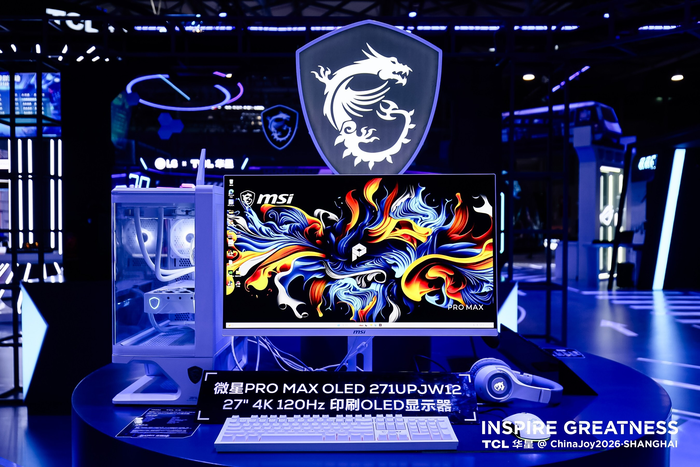
According to industry sources on Aug. 4, CSOT and MSI recently unveiled what they described as the world's first 27-inch 4K, 120Hz inkjet-printed OLED monitor at ChinaJoy 2026, a gaming exhibition held in Shanghai.
The MSI Pro Max OLED 271UPJW12 features a 164-pixels-per-inch (PPI) display and a standard RGB stripe subpixel layout. It supports peak high-dynamic-range (HDR) brightness of up to 1,000 nits and covers 99% of the DCI-P3 color gamut.
It is the first consumer monitor to be unveiled with an inkjet-printed OLED panel. CSOT is currently the only panel maker mass-producing IJP OLED panels, manufacturing them at its Generation 5.5 production line in Wuhan, China.
CSOT previously said it would also supply IJP OLED panels for Lenovo's Legion R9000P laptop, which was unveiled last month. The company is seen as using the IT market—starting with notebooks and monitors—as a foothold before expanding the technology into smartphones and televisions.
Until now, the large OLED monitor market has been dominated by white OLED (WOLED), which uses an open-mask process, and quantum-dot OLED (QD-OLED). These approaches create red, green and blue colors through color filters or quantum-dot color-conversion layers applied to white or blue OLED light sources.
IJP OLED, by contrast, directly forms red, green and blue subpixels through inkjet printing—a “real RGB” approach. Compared with conventional vacuum thermal evaporation, the process does not require expensive manufacturing equipment or fine metal masks (FMMs), a key component in RGB OLED production. It is therefore considered capable of improving manufacturing efficiency and reducing production costs.
CSOT's IJP OLED expansion is expected to gather pace. The company is building a Generation 8.6 OLED T8 inkjet-printing production line in Guangzhou, China, and is securing equipment for mass production targeted for late 2027. This is expected to significantly expand its production scale.
“CSOT's decision to target the IT market, where OLED adoption in monitors and laptops is now gaining momentum, rather than TVs, is raising concerns within South Korea's display industry,” a South Korean display-industry source said. “For now, adoption is centered on Greater China, where quality requirements are relatively less demanding and yield issues remain. But it could become a major threat if the technology expands to North American manufacturers.”
