






LG Electronics has introduced a financial connection service for B2B customers in the commercial display sector in the U.S., aiming to reduce the initial investment burden for large products through subscription-based sales and accelerate market expansion.
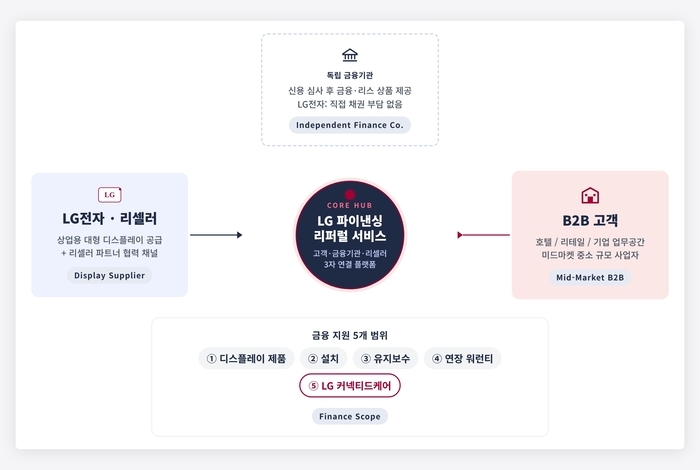
The company launched the 'LG Financing Referral Service' in the U.S., connecting participating financial institutions with customers to support their choice between 'purchase (CapEx)' and 'lease (OpEx)' when adopting commercial displays.
Target environments include hotels, retail spaces, and corporate workspaces, with operations initially limited to the U.S. Given that high initial costs—ranging from tens to hundreds of millions of won—have historically hindered adoption, the new approach is drawing attention.
This move signals a potential shift in LG Electronics' business structure from hardware-centric sales to a service-oriented model.
Financial support covers not only display products but also installation, maintenance, extended warranties, and LG ConnectedCare services. At the end of the lease term, customers can choose to replace, purchase, extend, or return the equipment.
The service targets businesses seeking to adopt necessary technologies within their available budgets. An LG Electronics representative stated, “Linking financial and leasing options will reduce investment burdens and enhance budget flexibility.”
Participating independent financial institutions provide financing and leasing products after credit reviews, while LG Electronics connects customers, financial institutions, and resellers. All financial approvals depend on the customer's creditworthiness. This strategy allows LG to expand customer touchpoints without directly assuming loan or lease liabilities, minimizing risks.
Earlier, LG Electronics overhauled its U.S. B2B channel partner program 'LG Pro' in Q2 and established region-based sales teams. This is part of expanding a 'collaborative' business model that co-designs solutions beyond product sales. IT services were also strengthened to handle Market Development Fund (MDF) applications, financial product recommendations, and discounts through a single platform.
In the U.S. B2B market, mid-market segments such as hospitality, retail, and corporate office spaces are characterized by faster decision-making compared to large enterprises and steadily growing demand for mid-to-large-scale solutions.
An industry insider noted, “While the hospitality and retail sectors have consistently demanded store renovations, they have maintained conservative budgeting. Leasing options that eliminate upfront capital expenditure appeal to small and mid-sized businesses, potentially transforming revenue structures from hardware sales to service-oriented models.”