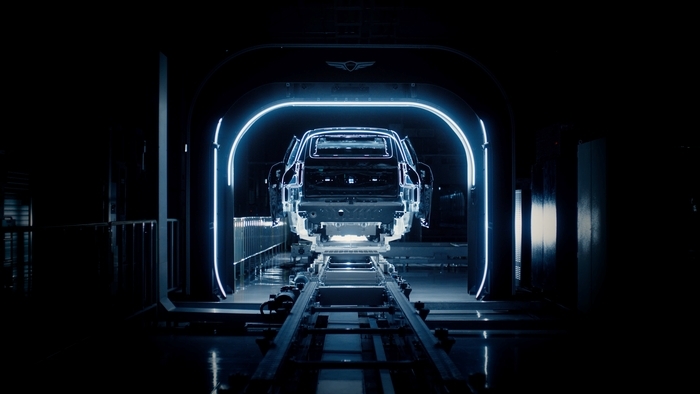






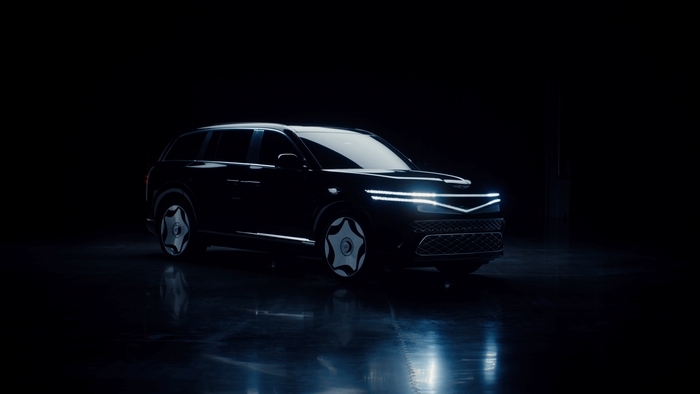
Genesis has unveiled the technology behind its upcoming GV90 flagship electric SUV, featuring pillarless coach doors, a roof-mounted airbag system and a new dedicated EV platform designed to raise the bar for safety, space and driving performance.
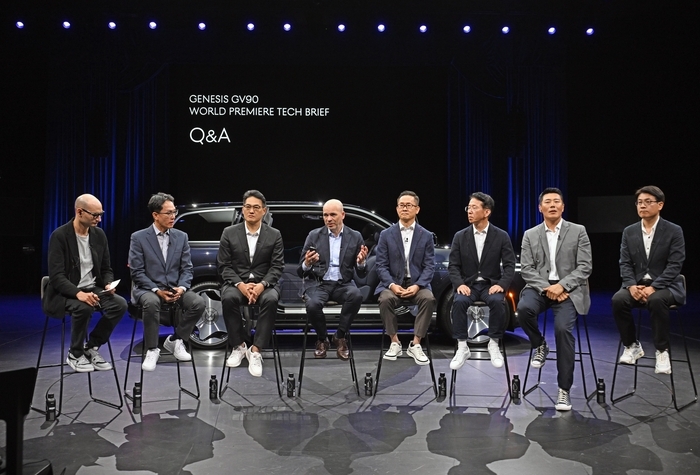
At the GV90 Tech Briefing held in San Francisco on Aug. 20 local time, Hyundai Motor Group's premium brand outlined the key technologies and engineering rationale behind the GV90 Neolun.
The SUV's “Neolun Arch Gate” coach-door design removes the conventional B-pillar—the vertical structural pillar between the front and rear doors—allowing the doors to open from the center in opposite directions.
The B-pillar is traditionally a critical part of a vehicle's body structure, helping absorb side-impact loads and maintain torsional rigidity. Eliminating it has long been considered difficult for mass-produced vehicles because it can weaken the body shell.
Genesis said it addressed the challenge by relocating the B-pillar structure into the doors and reinterpreting the principles of a racing-car roll cage, the protective internal framework used to shield drivers in a crash.
Coach doors without a fixed B-pillar have generally been limited to concept vehicles because the doors are difficult to engineer for reliable operation and structural integrity in a production vehicle.
“GV90 Neolun is the world's first customer-focused technology to enable door operation without a B-pillar, elevating even the brief moment of entering and exiting the vehicle,” said Lee Dae-hee, head of Genesis Body Design. “It delivers an entirely new boarding experience.”
Genesis has also equipped the GV90 with what it described as the world's first roof airbag system, designed to protect both the driver and passengers in a rollover. The system deploys across the full sunroof-glass area to help prevent occupants from being ejected through the roof opening.
The automaker said it validated the system through rollover tests and other crash scenarios intended to reflect real-world accidents.
“About 31.6% of ejection cases occur through the sunroof,” said Lee Seung-mok, executive vice president of Genesis Integrated Safety Development. “Our 12 advanced sunroof airbag modules are designed to protect occupants across a wide range of crash situations.”
The system is also designed to provide more than 320 millimeters of side protection space, exceeding the 180 millimeters associated with the highest existing safety rating.
The GV90 expands Genesis' flagship SUV dimensions and upgrades driving capability. It measures 5,285 millimeters long and has a wheelbase of 3,245 millimeters, offering more interior space than the Mercedes-Benz GLS, which measures 5,210 millimeters in length with a 3,135-millimeter wheelbase.
Genesis developed a new eMP platform exclusively for the vehicle to maximize cabin room and support its larger body.
The GV90 also features next-generation cameras intended to improve pedestrian and object recognition, addressing limitations in Highway Driving Assist 2, or HDA2, one of Genesis' advanced driver-assistance system functions.
A pop-up center display measures 23.6 inches while driving. When the vehicle is parked, pressing a dedicated button raises the screen by 90 millimeters, expanding it to 24.6 inches.
The SUV will also be the first Hyundai Motor Group model equipped with dual electronic limited-slip differentials, or E-LSDs, on both the front and rear axles. The system manages torque distribution across all four wheels at high motor speeds, improving cornering performance and providing greater stability on snow- and rain-covered roads.
“We will continue to improve the maturity of technologies currently in mass production under our next-generation autonomous-driving strategy, while steadily preparing future projects,” said Ahn Se-jin, executive vice president of Genesis Project 2.
Genesis plans to first introduce Level 2+ automated-driving technology in the G90 flagship sedan. It will then roll out Level 2++ urban automated-driving functions and Level 4 driverless technology in future SUV models.