








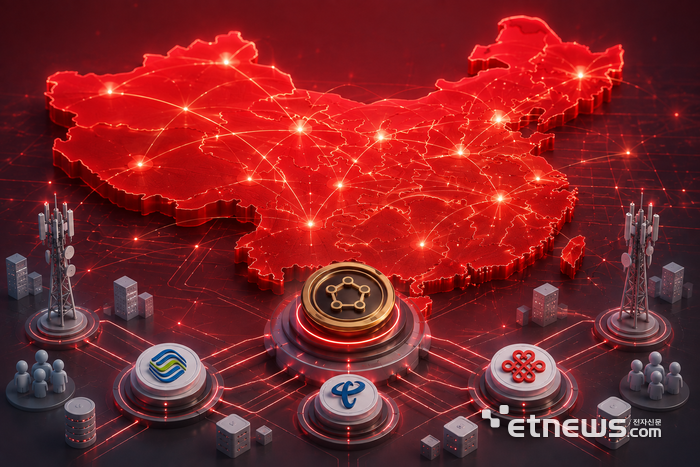
Major Chinese telecommunications companies were found to have generated over KRW2 trillion in revenue in the first quarter alone through their artificial intelligence (AI) token businesses. As the “token economy”—which measures, bills, and settles AI token usage—emerges as a next-generation revenue model for telcos following voice and data, South Korea is also moving beyond feasibility reviews to the commercialization stage.
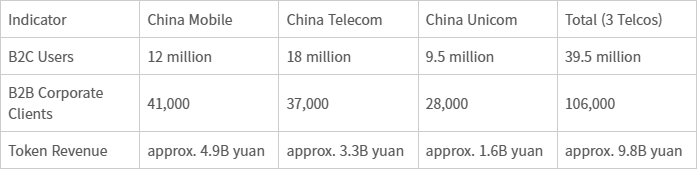
According to data recently analyzed by LG Uplus on the current status and commercialization feasibility of the domestic and international token economy, China's top three telcos—China Mobile, China Telecom, and China Unicom—generated a total revenue of 9.8 billion yuan (approx. KRW2 trillion) through their token businesses in the first quarter of this year. The total number of individual subscribers for token plans exceeded 39.5 million, and corporate clients surpassed 106,000.
Tokens are the smallest processing unit read and written by AI. Chinese telcos have established a monetization foundation with these monthly subscription-type token businesses. Billing is designed in two forms: a bundled type that adds AI to telecommunication products, and a standalone type that sells only tokens separately.
China Unicom's bundled plan provides data and internet for 359 yuan per month, along with 90,000 model requests including AI Cloud PC, DeepSeek, and Zhipu GLM. The standalone type sells tokens in capacity units like data. The token plan provides 1 million tokens for 7.5 yuan per month and 10 million tokens for 22.5 yuan per month. The coding plan aimed at developers bills based on the number of API calls rather than tokens.
The usage method is structured such that telcos broker multiple models. Subscribers combine and use different models for development purposes and multimodal processing. Since the token consumption rate differs by model, real-time usage check is provided and the consumed amount is disclosed.
Revenue is generated from a structure that brokers users, AI models, and computing infrastructure. After securing customers through existing channels, model routing and settlement are processed at the token hub. However, Chinese models are closer to placing AI usage on a telco-style billing system rather than making telecommunication networks AI-native. Not only China Unicom but also China Telecom unveiled a token hub targeting corporate customers, and China Mobile also formed a dedicated organization for AI token commercialization.
The report presented the token economy, which measures AI usage and optimizes costs, as a new business expansion opportunity for telecommunications companies.
In the background lies a sense of crisis over the shrinking position of telcos in the AI era. Unlike LTE, where network upgrades directly led to service evolution, the initiative for innovation after 5G has shifted to the cloud, and even the AI ecosystem is dominated by Big Tech. This stems from concerns that even in 6G, telecommunication networks could degenerate into a “dumb pipe” carrying AI data.
Movements in South Korea have also begun in earnest. KT put forward “Token Factory”—a platform that integrates and operates billing according to token usage—as a new business. The plan is to construct a gateway supporting token generation, brokerage, and billing by combining nationwide AIDCs (AI Data Centers) with a token optimization engine. SK Telecom also presented intelligent factories that produce and export tokens leveraging a 15GW-class AI factory as a future growth driver. Although LG Uplus did not disclose specific business implementation plans, it presented a blueprint through this report that 6G must evolve into an AI-native network that completes real-world AI at minimum token costs.
Experts view the core of the token business as technology that simultaneously optimizes models, GPUs, power, caching, and routing. Simple requests are sent to low-cost models, and repeated contexts are replaced with cache. Distributing processing times to increase GPU utilization or improving power and cooling efficiency to raise token performance per watt are also areas where telcos with AIDCs have an advantage.
