








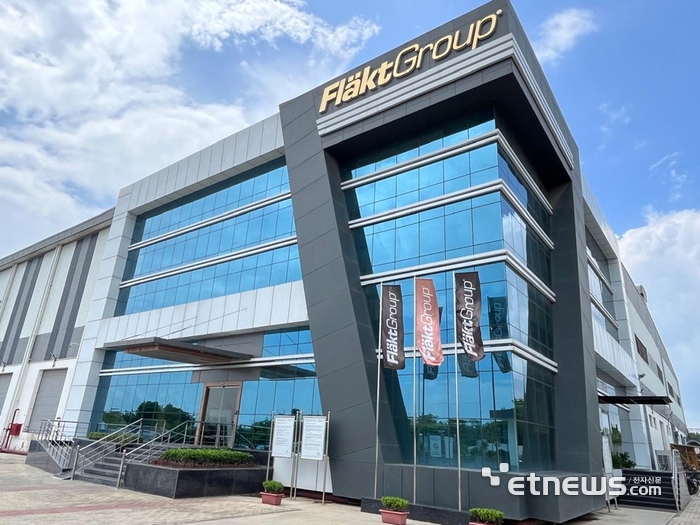
Samsung Electronics will shift foreign heating, ventilation, and air conditioning (HVAC) equipment production volumes from FlaktGroup, which it acquired last year, to Gwangju as early as next year. The company is coordinating with Jeonnam Gwangju Integrated Special City to finish building permit procedures this month and hold a groundbreaking ceremony next month.
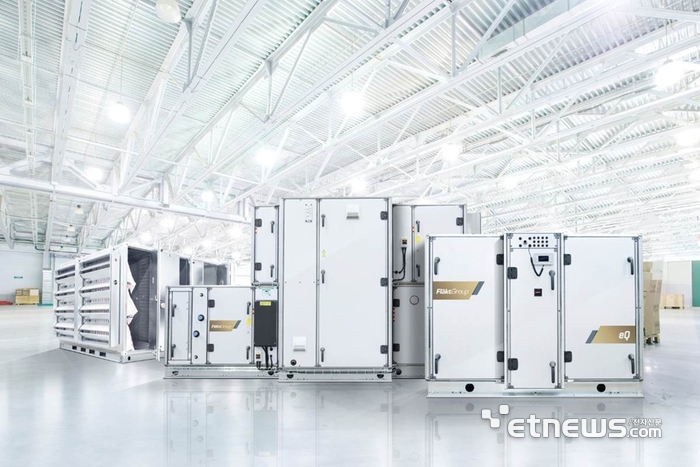
In line with active investments in artificial intelligence data centers (AIDCs), the company plans to directly produce central air conditioning and precision cooling equipment domestically to meet demand for large-scale projects.
Samsung Electronics is currently negotiating final building permit procedures with Jeonnam Gwangju City for the construction of the new HVAC plant. Since applying for a building permit from the city last month, working-level consultations have been ongoing for water supply and drainage systems and vehicle access roads around 1119 Oryong-dong, Buk-gu.
Jeonnam Gwangju City approved road occupancy for vehicle access facilities and road excavation for drainage system installation. Traffic impact assessments according to the factory expansion are also being conducted. Water supply reviews and building permit re-consultations have also been completed.
Samsung Electronics is discussing with the special city plans to receive building permits within this month and hold a groundbreaking ceremony next month.
The new FlaktGroup HVAC plant will be built at Samsung Electronics Green City Campus 3 within the Gwangju High-tech Science National Industrial Complex. The project will proceed by adjusting some production lines in existing facilities while expanding with a separate factory building on unused land within the campus. Samsung Electronics is reported to be investing about KRW200 billion in the construction of the new plant.
The Gwangju plant is expected to mainly produce central air conditioning and precision cooling equipment to be supplied to domestic AIDCs. This approach will shift a portion of the volume that was previously produced at FlaktGroup's overseas factories in Europe and imported into South Korea to Gwangju. As it establishes a direct domestic production system for products previously procured from abroad, import substitution effects can also be anticipated.
Initial production volume at the Gwangju plant is expected to be prioritized for meeting the rising demand for AIDC infrastructure construction across South Korea.
Based on the Gwangju plant, Samsung Electronics plans to target air conditioning demand for major domestic AIDC construction projects, including the National AI Computing Center. The company intends to maximize the geographical advantage of proximity between major clients and the production base. In addition, by shifting supply chains that relied on overseas factories back home, the company plans to meet deadlines for large-scale projects and respond promptly to customized design requests per client.
Separately, Samsung Electronics is also reviewing the expansion of overseas production volume. Since June, FlaktGroup has been investing with the goal of producing 6,500 units annually in Pune, India. Its main target markets are India, Asia, and Southeast Asia. The possibility of constructing a new local plant in the U.S. to target the North American market is also being raised.
An industry official said, “In a situation where large-scale AIDC investments are scheduled, securing a domestic production base for cooling equipment holds significance not only for delivery deadlines but also for maintenance and supply chain stability,” adding, “Institutional support, such as tax incentives, subsidies, and evaluation bonus points, needs to accompany this to encourage the use of domestically produced equipment in public and private data center projects.”
However, separate from the groundbreaking ceremony, a time lag may occur before actual construction begins. The key lies in the capture and relocation of narrow-mouthed toads, an endangered wildlife species discovered on the site of the planned new factory. Full-scale construction can only begin after completing the relocation completion report and on-site inspection by environmental authorities.
