






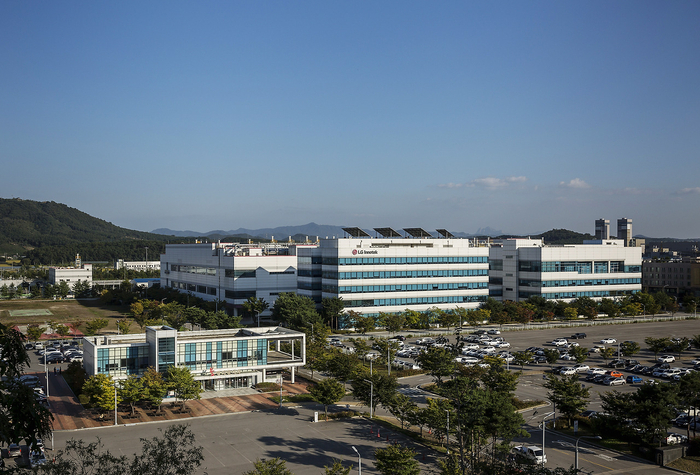
LG Innotek has begun mass-producing camera modules for humanoid robots, turning its robot “eye” business into a new growth engine. The company plans to use its plant in Paju, South Korea, as a production hub for robot camera modules as it prepares for higher-volume demand.
According to industry sources on Aug. 13, LG Innotek is currently mass-producing camera modules at its Paju plant for a North American humanoid-robot customer.
The customer is a humanoid robotics startup that has recently drawn industry attention and has already unveiled a development-stage robot. LG Innotek is confirmed to be supplying tens of thousands of camera modules for the model.
Humanoid robots typically use camera modules in both their heads and hands. LG Innotek's customer is reportedly installing between five and eight camera modules in each robot.
The customer is preparing not only development units but also a mass-production humanoid model. If LG Innotek secures a supply deal for that model as well, its production volume could increase substantially.
For humanoid robots to accurately perceive their surroundings, their heads require high-value sensor modules that combine cameras, lidar and radar. Their hands also need ultra-compact camera modules to recognize and handle objects.
Camera modules for humanoid robots must be lightweight to minimize the robot's overall weight and improve battery efficiency. They must also be cost-competitive to support eventual mass production. LG Innotek plans to build on the camera-module expertise it has developed in smartphones and automotive applications to accelerate its push into the humanoid-robot market.
The company selected its Paju plant as the main manufacturing base for robot components. The facility has produced 3D sensing modules for smartphones and extended reality, or XR, devices, as well as automotive camera modules.
LG Innotek plans to operate the plant as a manufacturing hub for “physical AI” sensing solutions, specializing in integrated sensing modules for autonomous driving and robotics.
The global robotics industry is targeting large-scale humanoid-robot production between 2027 and 2028. As humanoid adoption expands, competition for component orders among suppliers, including LG Innotek, is expected to intensify. Multiple component manufacturers are already in talks with global robot makers over potential supply agreements.
LG Innotek is also reportedly supplying camera modules to robot manufacturers beyond its current customer and is preparing for additional orders.
The company is differentiating itself as a “physical AI total solution provider.” In addition to sensing modules for humanoid robots, including camera modules, LG Innotek can supply connectivity modules, semiconductor substrates and other components. Its strategy is to provide customized, turnkey solutions and quickly establish a position in the emerging physical AI market.
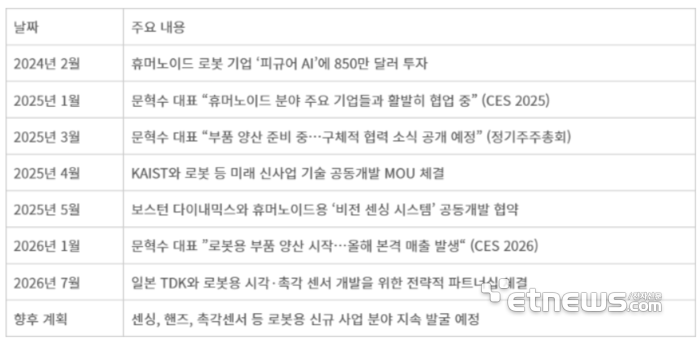
LG Innotek is also considering external partnerships and investments to strengthen its competitiveness in robot components.
“At CES 2026 earlier this year, we said we were continuously identifying new business opportunities, including areas such as robot hands,” LG Innotek CEO Moon Hyuk-soo said. “We will remain open to a range of possibilities, including partnerships and investments.”