








LG Group is expanding its AI data center business beyond cooling systems into full-stack AI factory solutions, following a meeting between LG Group Chairman Koo Kwang-mo and Nvidia CEO Jensen Huang. The group plans to package cooling, battery storage, power systems, data-center design, construction and operational capabilities into a single offering.
LG plans to build an AI factory reference site in the first half of next year to validate cooling, power and IT technologies using Nvidia's next-generation Vera Rubin AI platform.
In the first half of 2028, LG plans to scale the facility to 80 MW in Cheonan, South Chungcheong Province. The site will be used for applications including the training of LG's proprietary robot foundation models (RFMs). After validation, LG intends to offer the integrated solution as a package to global Big Tech customers.
An AI factory is a computing infrastructure that consumes data and electricity to train and run inference on AI models, producing tokens and machine intelligence. It is distinct from a conventional automated manufacturing plant that applies AI and robotics to physical production lines.
Until now, LG Electronics' AI data center business has focused on thermal-management equipment, including chillers, coolant distribution units (CDUs) and cold plates. The partnership broadens the scope: LG Electronics will contribute cooling technology; LG Energy Solution will provide batteries; LG CNS and LG Uplus will bring data-center design and operations expertise; and LS will supply power solutions.
The AI factories LG plans to build will also support its agentic AI and physical AI businesses. They will train and refine AI models for robotics and autonomous driving, then feed data collected from real industrial environments back into the models. LG describes this system as a “physical AI anchor” that connects intelligence developed in virtual environments with industrial sites and everyday life.
LG intends to expand its robotics business from manufacturing and logistics demonstrations into the home. This year, it plans to deploy its wheeled-base robot, LG CLOiD, on a washing-machine production line in Tennessee. In the first quarter of next year, it plans to unveil a bipedal humanoid robot based on Nvidia's Isaac GR00T platform.
By accumulating operational data from factories as well as robot-control and safety technologies, LG ultimately aims to build a “zero-labor home,” where appliances and robots take over household work.
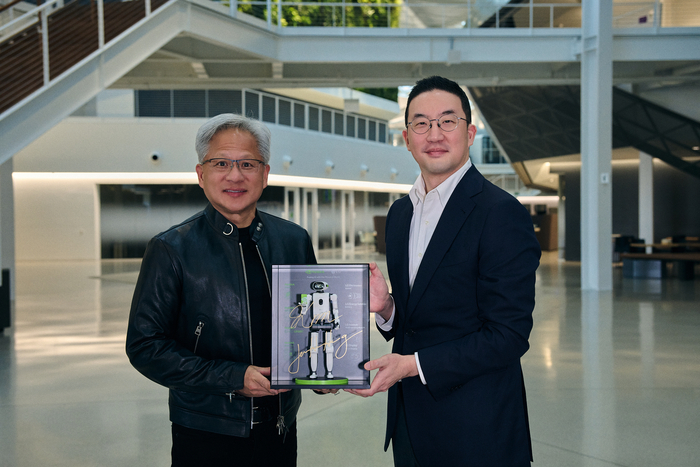
The initiative is the first detailed commercialization model to emerge roughly two months after a “samgyeopsal meeting” in Hongdae, Seoul, in June. Among the Korean companies that attended, LG is the first to turn the full physical AI value chain—from robotics validation in manufacturing sites to AI factory construction and autonomous-driving platforms—into a concrete business model.
The division of responsibilities between the two companies has also become clearer. Nvidia will supply AI models and computing platforms, while LG will provide the cooling and power infrastructure—as well as the real-world foundations for AI deployment in robots, vehicles and other applications.
LG's broad business portfolio is seen as a key reason it was able to move quickly on Nvidia's physical AI roadmap. Its capabilities span consumer appliances, automotive components, batteries, sensors and data-center cooling systems.
“Through this collaboration, LG will accelerate its transition into a global solutions provider and a physical AI anchor, linking AI intelligence in virtual space with real industrial sites and daily life,” an LG representative said. “In AI infrastructure, we will build full-stack capabilities and aim to become a top-tier global AI factory provider.”
Meanwhile, Madison Huang, Nvidia's senior director of Omniverse and Robotics Product Marketing and the eldest daughter of Jensen Huang, is scheduled to visit LG Electronics' R&D campus in Yangjae, Seoul, on the 18th. She is expected to hold private discussions with senior LG Electronics executives on a potential partnership at the data factory currently being built by LG.
The visit by a key Nvidia executive in physical AI and robotics comes shortly after Koo and Huang met at Nvidia headquarters in the United States, raising expectations that cooperation between the two companies will accelerate.
