







LG Electronics Inc. and Nvidia Corp. will jointly secure a large amount of robot data, equivalent to 12 years, within the year. LG Electronics will accumulate data using hundreds of robots, including 'LG CLOi', and feed it back into robot learning through augmentation and synthesis processes in connection with Nvidia's robotics solutions.
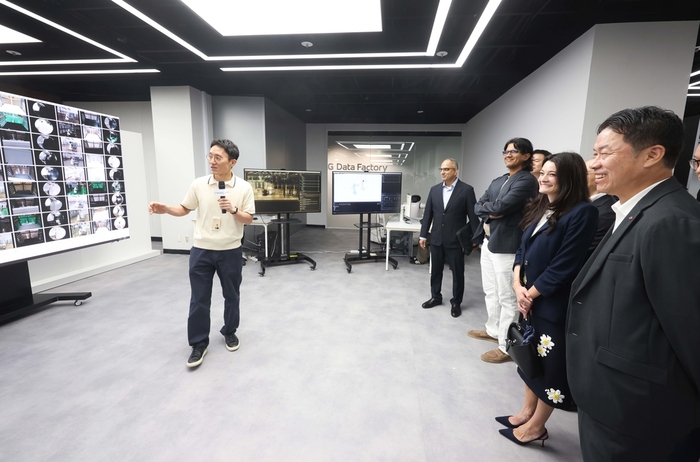
LG Electronics invited key officials, including Madison Huang, senior director of Omniverse and robotics product marketing for physical AI at Nvidia, to the Data Factory in Yangjae-dong, Seocho-gu, Seoul, on Aug. 18 to hold working-level discussions to accelerate robotics collaboration.
This meeting comes four days after Koo Kwang-mo, chairman of LG Group, and Jensen Huang, chief executive officer (CEO) of Nvidia, signed a memorandum of understanding (MOU) for strategic business cooperation at Nvidia's headquarters in the U.S. on Aug. 13 (local time). It is interpreted as an agreement to operate the robotics collaboration system early and accelerate commercialization.
The total amount of training data that LG Electronics expects to collect and generate through amplification and synthesis at the Yangjae Data Factory by the end of the year is expected to reach 100,000 hours. Based on this, the company plans to advance its own Robot Foundation Model (RFM) and unveil a bipedal humanoid in the first quarter of next year.
The LG Electronics Data Factory is an infrastructure where robots learn various tasks and verify and refine the learned data. With a total floor area of 10,000 square meters across four floors from the first basement level to the third floor above ground, it generates and collects robot data by deploying 'LG CLOi'.
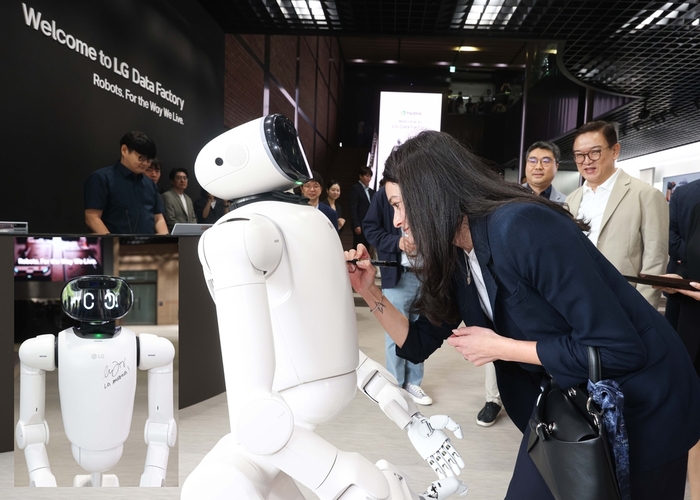
Data collected in real spaces is expanded using Nvidia's physical AI technology. By applying the Nvidia Omniverse library, Cosmos open world model, and Isaac robotics development platform, it changes the task environment and conditions of data, and synthesizes and amplifies virtual data. It is a method of increasing data scale so that actual robots can learn various task conditions without having to repeat every situation.
The secured data is used for training and performance improvement of its own RFM. It establishes a 'data flywheel' that deploys robots to manufacturing, logistics, and living spaces to secure new data and retrain it. The strategy is to turn the structure, in which not only robot hardware but also high-quality data is repeatedly accumulated, into a core asset to differentiate itself from competitors.
“We will secure physical AI competitiveness and reborn as a total robotics solution provider through synergies based on 'One LG' that concentrates core capabilities within the group and strategic collaboration with global partners,” said Lyu, CEO of LG Electronics.
