








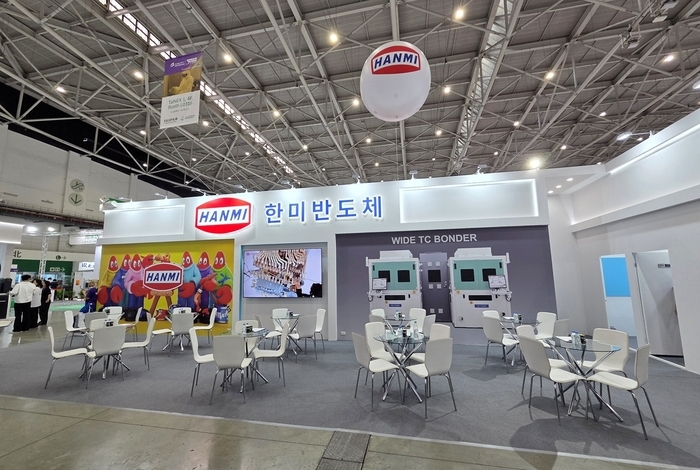
Hanmi Semiconductor has entered the supply chain for Taiwan foundry companies' packaging mass production lines.
According to industry sources on the 2nd, Hanmi has secured a Taiwan foundry company as a customer and begun supplying packaging (bonding) equipment for AI system semiconductors. This marks the first time a South Korean packaging equipment (2.5D) has passed a Taiwan foundry's mass production qualification (quality certification) and been deployed.
The contract counterpart and scale remain undisclosed, estimated to be slightly below the disclosure threshold. Hanmi's consolidated revenue last year was 576.7 billion KRW, with the minimum disclosure requirement for single sales/supply contracts on KOSPI being 5% of revenue, approximately 28.8 billion KRW. The order volume is reported to be in double digits.
Bonding is a critical process in packaging that determines where and how chips are attached. Originally specializing in HBM bonders (bonding equipment), Hanmi has expanded its product portfolio to include 2.5D packaging bonders since last year. This supply signifies that Hanmi's 2.5D packaging bonder has passed the mass production standards of a foundry customer.
Hanmi's strength lies in equipment versatility. Recently, varying die sizes and substrate specifications demanded by customers make it difficult for a single equipment model to meet all needs.
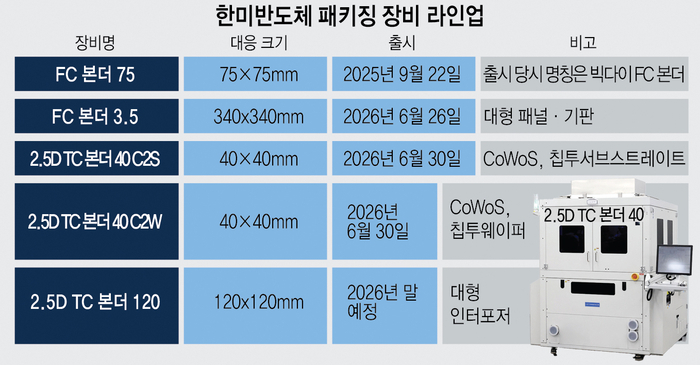
Hanmi has secured five 2.5D packaging equipment types, categorized by area and process: two flip-chip (FC) bonders and three thermocompression (TC) bonders. The FC Bonder 75, released in September 2025, handles large 75mm interposers, while the FC Bonder 3.5, launched in June, processes panels/substrates up to 340mm. For TC, the lineup centers on the 2.5D TC Bonder 40 for chip-on-wafer processes, with configurations split for chip-to-wafer (C2W) and chip-to-substrate (C2S) methods. A 120mm-class TC bonder for larger interposers is targeted for year-end release.
Demand for packaging equipment is expected to grow steadily. This is driven by strained packaging capacities at major foundries due to rising AI accelerator demand. In Taiwan, foundries are expanding in-house lines while outsourcing more front-end processes (chip-to-wafer attachment) to OSAT partners like ASE, SPIL, and Amkor. Since foundries set process and equipment standards while partners build lines, bonding equipment demand is expanding beyond foundry headquarters.
Hanmi is aligning with this trend by focusing on customer expansion. It is pushing to establish HanmiUSA by year-end. In the U.S., demand is growing not only for HBM but also for Amkor's back-end expansions, foundry-linked packaging, and Intel's EMIB (Embedded Multi-die Interconnect Bridge) initiatives.
Securing market share post-mass production remains a key challenge. The global logic/flip-chip bonder market is still dominated by incumbents like ASMPT, Besi, and Kulicke & Soffa (K&S).
An equipment industry insider noted, “While Taiwan's foundry ecosystem is conservative toward Korean equipment due to security concerns, breaking into mass production lines is significant. It's a critical reference for Hanmi's shift from HBM equipment to a system packaging equipment company.”
