








Beyond the open-source database (DB) domain, EDB is expanding its business into the data and AI platform market, integrating transactional (OLTP), high-speed analytics, and AI workloads into a single engine.
This marks a direct challenge to the enterprise data platform market, which has been dominated by commercial lakehouse providers like Snowflake and Databricks. EDB unveiled proprietary technology to address the 'exploding LLM token costs'—a major pain point for companies adopting generative AI—positioning data fragmentation resolution and AI cost reduction as core competitive strengths.
◇Unifying Transactions, Analytics, and AI… Integrated Data Platform 'Agentic Lakehouse'
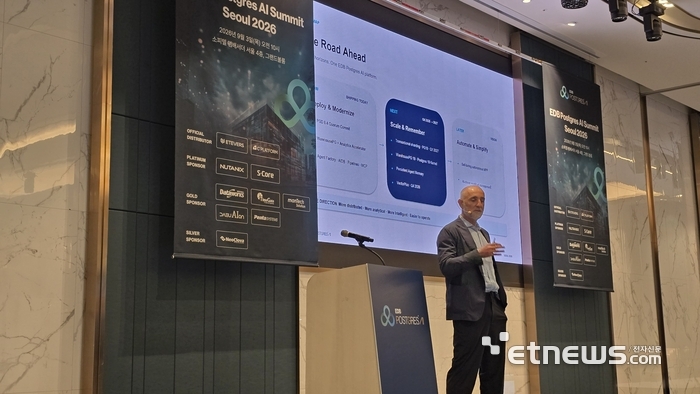
On the 3rd, EDB hosted the largest PostgreSQL conference in South Korea, the 'EDB Postgres AI Summit Seoul 2026,' at the Sofitel Ambassador Seoul. Frank Cid, EDB's Global Vice President of Analytics & AI Sales Engineering, delivered the main keynote on the theme 'Agentic Shift.'
Cid noted that while the global analytics and AI platform market is expected to grow to $218 billion by 2028, most enterprises are stuck in 'analytics sprawl,' managing at least four disparate systems—operational DBs, data warehouses (DW), lakes, vector DBs, and ETL pipelines. This leads to over 90% of AI projects being delayed or failing due to data silos.
As a solution, EDB presented the 'Agentic Lakehouse' architecture. Built on a single open Postgres engine, this platform organically integrates five core functions under one SQL interface and unified security framework. At its core is the 'operational database' for core business tasks, linked with 'ClickHouse OLAP' for real-time telemetry and log data analysis at sub-second speeds.
Additionally, 'WarehousePG (WHPG),' an open-source petabyte-scale massively parallel processing (MPP) data warehouse replacing Snowflake and Greenplum, drives large-scale analytics with in-database ML capabilities.
The platform is further supported by 'PGAA and PGFS,' an analytics acceleration engine that enables querying Apache Iceberg and Parquet open table formats 3.5x to 5x faster than traditional Postgres. EDB also provides an 'AI Agent Framework' to simplify AI agent development and deployment.
A key strength is eliminating the need for complex data pipelines or replication (ETL), directly leveraging open table formats to reduce data movement costs and security risks.
Notably, EDB announced plans to release its next-gen data warehouse engine, 'WarehousePG 19,' in the first half of 2027 (H1). Featuring 'Property Graph' for financial fraud detection (FDS) and supply chain analysis via standard SQL/PGQ—without a separate graph DB—and Iceberg streaming write technology, it aims to compete head-on with commercial solutions.
◇Reducing LLM Token Costs by 80%
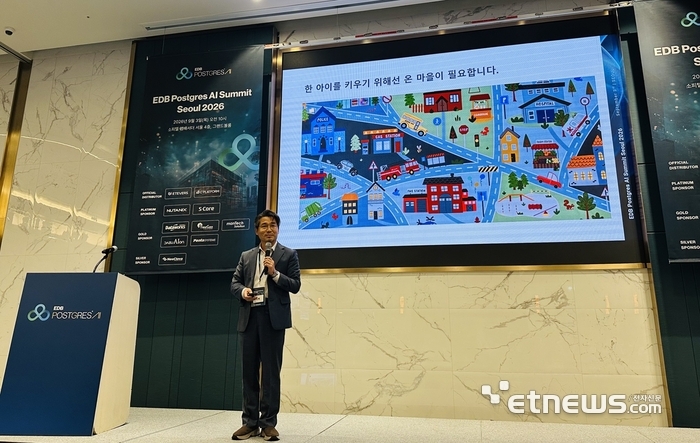
Sidney, the Vice President, highlighted that the structural limitation of having to resend the entire context with every interaction when using AI models leads to exponentially increasing operational costs—referred to as “token economics”—as AI services scale, making this a critical issue for all enterprises.
He then introduced EDB's “Persistent Agent Memory” technology as a solution. This technology compresses conversation histories efficiently and integrates relational, vector, and graph memory within a single ACID-compliant database, enabling over 80% reduction in LLM token costs.
The AI agent's data state is securely protected within an “independent security boundary” inside the database. Companies that adopted EDB's AI agent development and operations framework, “Agent Factory,” achieved a significant reduction in production deployment time—from 28 weeks to 9 weeks—and cut development effort by 67% compared to in-house (DIY) approaches. These results demonstrated that token cost savings directly accelerate commercialization.
◇ Leading Companies Prove Success: IBK Industrial Bank, Kyobo Book Centre, Shopcast
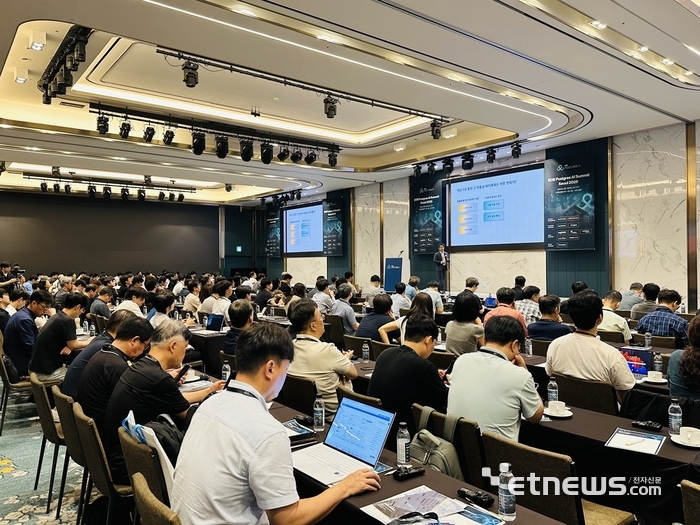
At the event, practical leaders from major domestic and international corporations and financial institutions shared success stories of open-source transitions (OX) and AI platform implementations. IBK Industrial Bank overcame challenges such as Oracle licensing costs, vendor dependency, and scalability limitations by migrating 15 systems in parallel to an EDB Postgres Advanced Server (EPAS) foundation within a year.
By transitioning from storage replication to an EFM HA system based on WAL streaming, they reduced failover time. They also announced plans to link internal AI data infrastructure using Postgres vector extensions in the future.
Kyobo Book Centre shared expertise on successfully migrating to an open-source database under an enterprise DB modernization strategy, integrating operational, analytical, and AI-based book recommendation services on a unified Postgres platform.
Shopcast, a music streaming and copyright settlement platform, presented its handling of 7 billion annual music playback logs and 1.8 billion quarterly copyright settlement records. After migrating from a legacy commercial DB and Hadoop environment to EDB Postgres Lakehouse, they reduced quarterly settlement batch processing from 40 minutes to 7 minutes. They also implemented a system where non-technical executives can query data via natural language using an AI agent.
A domestic semiconductor group introduced a coexistence strategy, maintaining existing commercial MPP DBs while adding WarehousePG as a new option within their internal DBaaS platform. After rigorous technical validation (PoC) across four axes—compatibility, performance, stability, and operations—they confirmed performance equivalent to commercial products for key analytical workloads.
Kim Hee-bae, Managing Director of EDB Korea, stated, “EDB is the only vendor in Korea, and globally, that provides a unified data platform spanning transactions, analytics, and AI. Whether cloud, bare metal, hybrid, or serverless, enabling customers to freely configure data infrastructure in any environment is the core of what we call Enterprise Open Source Transition (OX).”
