





A deep-tech startup tackling in-flight Wi-Fi dead zones with a power-free reflective film
ADWAVE Co., Ltd. (CEO Na Jun-hee), a deep-tech startup that solves Wi-Fi dead zones in aircraft cabins with a film that needs no power, is taking part in the “2026 Public-Private IP Strategy Support Program (CIPO Program)”, run by Korea's Ministry of Intellectual Property and the Korea Invention Promotion Association (KIPA), and is receiving outside CIPO (Chief Intellectual Property Officer) support from the program's operator, DARAE Strategy & Business, Inc..
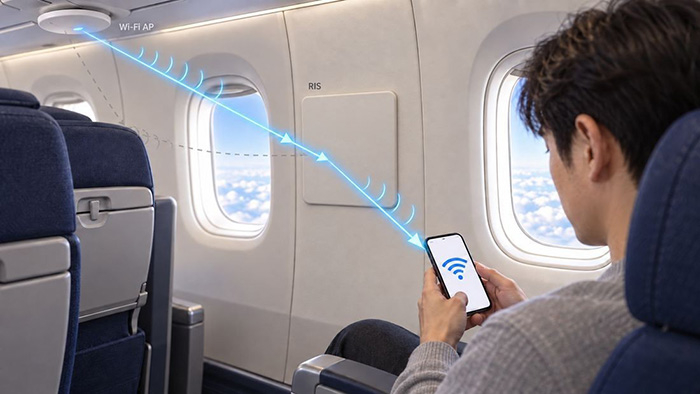
In-flight Wi-Fi is becoming standard as low-earth-orbit satellite internet spreads, yet the metal fuselage, galleys and bulkheads still keep the signal from reaching some seats. Founded in October 2024, ADWAVE attaches a thin patterned film (RIS, reconfigurable intelligent surface) to ceiling or side-wall panels so that the signal from existing wireless access points (APs) is reflected toward those seats. Because it needs no power, wiring or electronic parts, the burden of modifying the aircraft is small.
The reflection patterns are designed for each aircraft type and cabin zone with AI-based inverse design, and the film is produced thin and light using display manufacturing processes. The team is led by CEO Na, who worked on display processes and materials at Samsung Electronics and Apple, together with an antenna and RF expert from Samsung Electronics and specialists in AI design automation.
In August 2026, ADWAVE built a 6-inch RIS prototype that works on Wi-Fi and 5G bands (3.4/5.3 GHz) at the same time and completed bench measurements. A single panel weighs only 25 g, and the company confirmed that simulation results for its AI-designed unit structure match the measurements, raising confidence in its design technology.
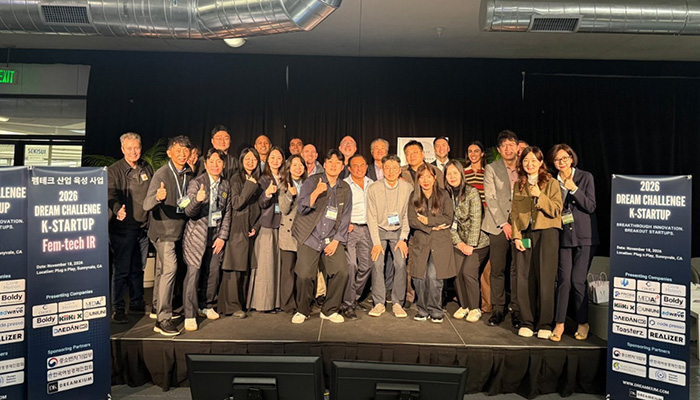
The company has also begun reaching out to investors abroad, holding an IR session at Plug and Play, a startup accelerator in Silicon Valley. The starting point of the business was demand raised first by cabin engineers at a global aircraft manufacturer, and the company is now preparing proof-of-concept discussions with airlines and cabin component suppliers.
ADWAVE has also strengthened its IP base. As of September 2026, its portfolio comprised 10 patents, including six registered patents, and in the second half of the year it filed two more Korean patent applications and one international (PCT) application. It is also carrying out a TIPS R&D project.
ADWAVE aims to raise a pre-Series A round in the first half of 2027 while continuing to develop a transparent RIS film prototype and validate it in cabin environments. It plans to extend the technology proven in aircraft cabins to other spaces where radio signals are blocked, such as railways, vehicles and factories.
“Aircraft cabins are among the most demanding spaces for radio signals, so we will prove our performance there first,” said Na. “With technology that creates seamless connectivity without power or wiring, we will expand into other spaces such as factories, logistics sites and buildings.”
