








Samsung SDS has unveiled an execution strategy to transition from a company “adopting AI” to one that “achieves results with AI.” The company emphasizes that success hinges not on AI adoption itself, but on restructuring workflows and business models afterward.
The business expansion includes deepening collaboration with global frontier AI companies like OpenAI and Anthropic, as well as broadening into robotics-driven manufacturing innovation.
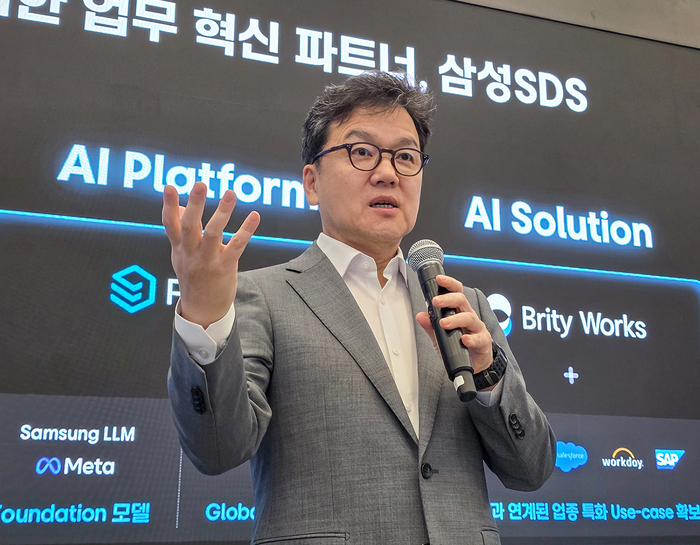
On the 8th, Samsung SDS held the Enterprise AI Transformation (AX) conference “Real Summit 2026” at COEX in Seoul, unveiling its “Multidimensional AI Full-Stack” strategy. Over 8,000 attendees participated on-site, with a total of 15,000 viewers online.
◇“AI Changes Tasks, AX Transforms Businesses”
In his keynote, President Lee cited a McKinsey survey: “88% of companies reported adopting AI for at least one task, but only 6% saw meaningful profit contributions from AI.”
He diagnosed a gap between AI adoption and business outcomes, attributing it not to AI itself but to the “container” holding it—the work processes. Lee identified seven conditions for successful AI adoption: process redesign for human-AI collaboration, data structuring for AI usability, multi-agent AI systems, governance for AI actions, AI security, AI-friendly organizational structures, and corporate culture shifts—collectively defining AX.
He stressed, “AX is a fundamental shift beyond mere cost/time savings through AI. AI changes tasks, but AX transforms businesses.”
Samsung SDS is applying these seven conditions internally first via the “Client Zero” strategy, targeting seven core functions: development, procurement, quality, management support, project execution, marketing, and sales. The company validates results internally before offering solutions to clients.
It also plans to expand Field-Dense Engineers (FDEs) to 200 by year-end through partnerships with OpenAI, Anthropic, and Accenture.
President Lee noted, “A true AI full-stack must provide consulting, development, deployment, and operational expertise—only possible with deep client business understanding.”
◇OpenAI, Anthropic Partnerships and RX Business Announcement
Alongside AX strategies, Samsung SDS announced territorial expansion, including collaborations with global AI leaders and robotics-driven manufacturing.
As the first Korean company, Samsung SDS joined OpenAI's security automation program “Daybreak Partner Program” as a pilot partner. Daybreak automates vulnerability detection, risk validation, prioritization, patch generation, and testing. Samsung SDS plans to integrate this with its large-scale system expertise to commercialize security services.
With Anthropic, it reaffirmed strategic partnerships established in July in San Francisco. OpenAI Korea's Kyung-hoon Kim and Anthropic Korea's Ki-young Choi jointly presented collaboration directions, while Sam Altman, OpenAI CEO, praised Samsung SDS as a “global top-tier partner” via video message.
The company also officially declared entry into the “Robotics Transformation (RX)” business. Building on 25 years of experience deploying Manufacturing Execution Systems (MES) and automation for 430+ clients in semiconductors, batteries, and biotech, Samsung SDS will expand into robotics.
Starting next year, it will launch a “Robot Orchestration Platform” to unify control of multi-vendor robots via a single software. If one robot stops, the system detects it in real-time and reroutes tasks to others, preventing factory-wide halts—a “robot-specific control tower.”
Ecosystem partnerships accelerated with “Team REX,” including 10 global physical AI companies like Rainbow Robotics and Walden Robotics. A strategic investment and collaboration agreement with Walden Robotics (founded by former Toyota researchers) aims to co-develop manufacturing applications.
◇'Brightics Works Cowork' Commercialization in October: From Answering AI to Working AI
A new collaboration solution was also unveiled. “Brightics Works Cowork,” commercializing in October, goes beyond information retrieval to autonomously handle tasks: goal planning, research, report writing, email sending, and scheduling. It understands workplace context (emails, chats, calendars) and integrates with enterprise systems, including security governance to prevent data leaks.
Case studies were presented, including GS Caltex (next-gen ERP/workflow redesign), Dongwon Group (global communication innovation via Brightics), and Vessel AI (GPU utilization improved from 35% to 90% via Samsung Cloud Platform).
Post-keynote, 59 sessions across 10 tracks (AX strategy, manufacturing, retail, logistics, public sector, defense, finance, etc.) followed.
President Lee concluded, “With our unique multidimensional AI full-stack technology and top-tier global AI ecosystem, we will be a trusted partner in clients' successful AX journeys.”
