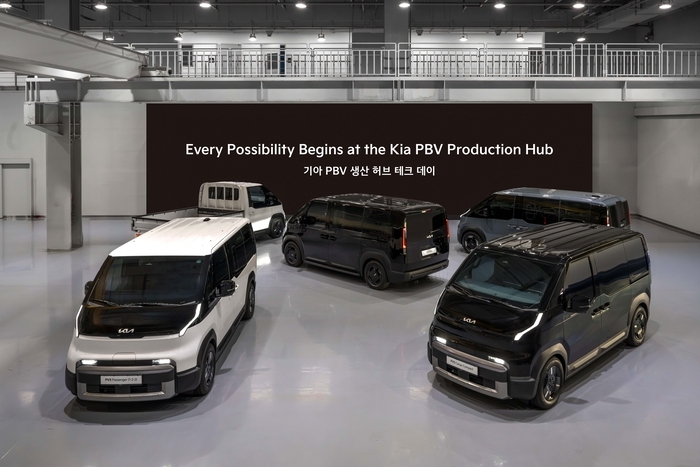







Kia is accelerating its push into the personalized mobility market with a two-track strategy that combines advanced smart manufacturing at its dedicated purpose-built vehicle, or PBV, factory with a customer-focused vehicle-conversion ecosystem.
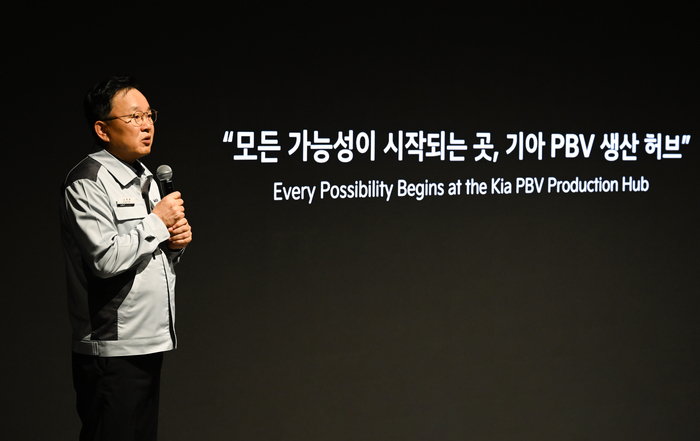
At its Kia PBV Production Hub Tech Day at AutoLand Hwaseong in Gyeonggi Province, Kia outlined the manufacturing innovations behind its dedicated Hwaseong EVO Plant, as well as the operating strategy and long-term vision for its nearby PBV Conversion Center.
The Hwaseong EVO Plant consists of the East plant, which covers about 100,000 square meters and is currently producing the PV5 PBV, and the West plant, which will span roughly 130,000 square meters and manufacture larger PBVs including the PV7.
Once the West plant is completed in June 2027, the combined facility is expected to have annual production capacity of 200,000 vehicles.
The operational East plant uses a “4-buck sequential assembly” method, which divides body assembly into four stages, along with precision vision robots. The system is designed to enable flexible production of vehicles in a wide range of configurations.
The West plant will introduce more advanced technologies to accommodate larger vehicle bodies and a growing number of derivative models. Kia plans to split the body-production line across two separate buildings and deploy autonomous mobile robots, or AMRs, as well as remote equipment-control systems.
Kia is also expanding beyond the production of base vehicles by building a conversion ecosystem that can customize PBVs for specific business and customer needs. The PBV Conversion Center, located north of AutoLand Hwaseong and linked directly to the main facility by a dedicated road, has annual capacity to produce 40,000 specialized vehicles and is already mass-producing customized models based on the PV5.
Kia said it has established a dedicated conversion process by incorporating wiring provisions and mounting holes for specialized equipment at the design stage. This allows precise modification work to be carried out without damaging the vehicle body.
The automaker will also support external conversion partners with “donor models,” which exclude unnecessary interior components, as well as 3D CAD data. Kia plans to roll out partnership models based on the PV5—including police patrol vehicles, refrigerated vans, and welfare-accessible vehicles—sequentially within the year.
The PV5, produced at AutoLand Hwaseong, has gained traction in global markets, surpassing 40,000 units in sales this year, according to Kia. Building on the model's momentum, Kia plans to unveil the larger PV7 to the world for the first time at IAA Transportation 2026, which opens in Hanover, Germany, on Sep. 14.
Kia aims to extend the momentum of its PBV business by leveraging its Hwaseong production capabilities and expanding its lineup of dedicated purpose-built vehicles.
“AutoLand Hwaseong is more than a production plant—it is a PBV manufacturing hub that turns the needs of customers and partners into reality,” said So Deuk-young, Executive Vice President and Head of Kia AutoLand Hwaseong. “We will continue advancing smart manufacturing technologies and the conversion ecosystem to unlock the diverse possibilities of personalized mobility.”