







SK Telecom and LG Uplus are targeting the Southeast Asian telecommunications market with their reliable artificial intelligence (AI) technological competitiveness. Their strategy is to penetrate the AI transformation (AX) demand of local telecom companies through their primary capabilities, such as AI infrastructure and voice AI, and to uncover business opportunities using security and technology sovereignty cooperation as a link.
According to the telecommunications industry on the 10th, both companies participated in 'GSMA M360 ASEAN 2026', which opened in Kuala Lumpur, Malaysia, starting on the 9th (local time). Telecom operators, tech companies, and policy authorities from East Asia and ASEAN attended the event to address pressing issues such as AX, AI sovereignty, security enhancement, and trusted telecom networks.
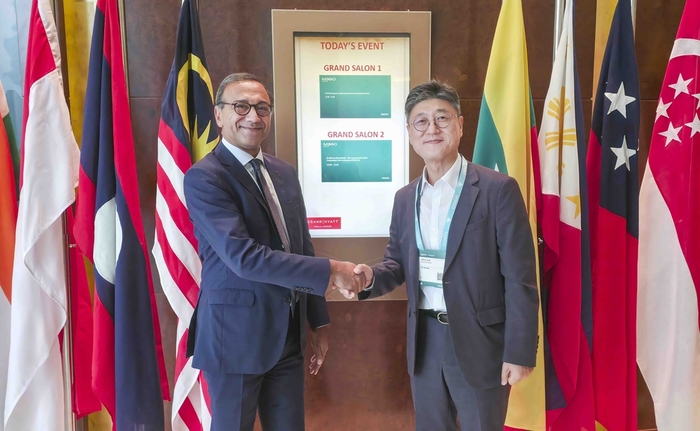
For SK Telecom, CEO Jung Jae-hun met with Vivek Badrinath, director general of the GSMA, to discuss next-generation growth opportunities for the AI-based telecom industry and strategies for the AI-centered transformation of telecom infrastructure. Jung explained the AI full-stack strategy encompassing everything from infrastructure to models and services with the goal of leaping forward as the 'Asia AI Infrastructure Hub', and also explored cooperation measures such as strengthening information protection systems, preventing digital crimes, and upgrading AI-based networks.
Jung also attended a roundtable with executives from major Asian telecom and tech companies in Japan, Malaysia, Indonesia, and Singapore. Participants agreed that securing trust through security enhancement, securing technological sovereignty, and governance restructuring is the core of future competitiveness. He also met with Tradewinds, an investment company affiliated with Malaysia's Albukhary Group, to discover cooperation opportunities.
Jung said, “In the AI era, the capability to gain the trust of customers and society determines corporate competitiveness as much as the speed of technological innovation,” adding, “We will concrete cooperation in the field of digital trust with global telecom operators and create a sustainable AI ecosystem.”
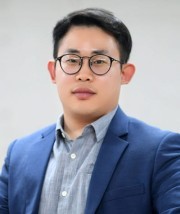
For LG Uplus, Executive Consultant Kim Jae-yeol presented at the roundtable under the theme 'Voice AI: Transforming Telecom Voice Data into Trusted Value'. The concept is that telecom operators can provide new services by combining local voice-language-based AI with customer touchpoints secured in non-English speaking environments using various languages by country. LG Uplus is seeking business expansion into other Southeast Asian regions by exporting its AI call service 'ixi-O' to Malaysian telecom operator Maxis.
In the summit panel discussion that followed, future revenue sources for telecom operators, their roles within the global AI ecosystem, and the commercial value of AI based on native technology were discussed. LG Uplus emphasized its Voice AI competitiveness, stating that telecom operators' AI strategies should expand not only to infrastructure construction but also to the service areas that customers use.
In the industry, as Southeast Asian countries step up to build AI based on their own languages and data, the AX experience of domestic telecom operators can mesh with local cooperation demand. Telecom operators plan to accelerate their push into the ASEAN market, which has high growth potential.
