




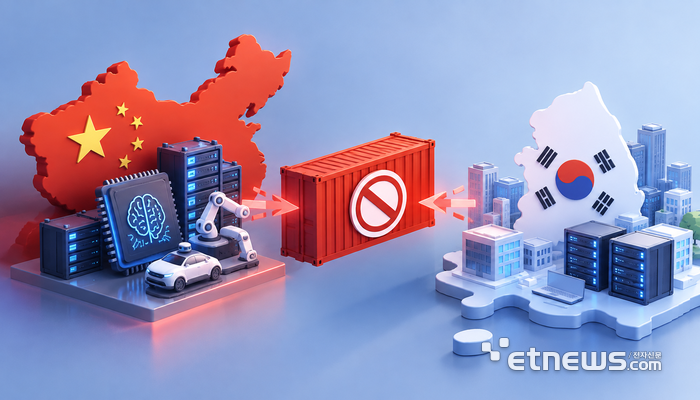
The South Korean government has launched an emergency survey to gauge how China's restrictions on exporting artificial intelligence (AI) technology are affecting domestic companies. The survey covers the use of Chinese AI models, the business impact of the export controls and plans to secure alternative technologies, with the aim of drawing up a response.
The Ministry of Science and ICT surveyed Korean software and AI companies on the effects of China's restrictions on advanced technology exports, industry sources said on Oct. 29. The ministry closed the questionnaire for member companies of the Korea Artificial Intelligence and Software Industry Association (KOSA) on Oct. 28 and is now compiling and analyzing the results.
On Oct. 16, the Chinese government began collecting public comments on revising its catalogue of technologies prohibited or restricted from export. The draft covers core technologies such as ultra-large AI models with 2 trillion or more parameters and AI agents. The list is still at the stage of gathering industry input, but a requirement to register with authorities in advance (including the destination, technology and intended use) for overseas technology transfers and exports took effect the day it was announced.
In response, the Korean government surveyed companies to understand how Chinese measures could affect the domestic AI industry. The first part of the survey examined how Korean firms use Chinese AI models, asking whether they have adopted DeepSeek, Alibaba's Qwen, Tencent's Hunyuan or Moonshot AI's Kimi, and in what form, such as on-premises deployment or application programming interface (API) integration. It also asked why companies adopted them and whether they run U.S. or domestic AI models alongside them.
The survey also assessed business risks from the export curbs. It asked about the possibility of serious damage, such as halted development or forced replacement of core infrastructure, and whether restrictions on exporting model weights could disrupt technology development. It also looked at whether companies would face extra costs to secure alternative models, and at regulatory risks in overseas business.
Within the AI industry, there are concerns that China's export curbs could increase uncertainty in technology development. Many Korean AI companies fine-tune foreign models for their own use, so tighter regulation could disrupt their work.
“As the performance of Chinese models improves, their use is growing in Korea as well,” an AI company official said. “We can still use APIs and web services, so there is no immediate disruption to our business. But if the Chinese government restricts even the use of open-source models, it could constrain our technology development in the long run.”
The government plans to review each company's regulatory response and its demand for policy support based on the results. The survey is also expected to give a sense of the scale of Chinese AI model adoption in Korea and how the models are used.
“The impact varies by company depending on how they use the models and technology, so we gathered a wide range of industry views through the private sector,” a ministry official said. “We will use the results as a reference for policy planning.”
