





Secures Deals with 10 Clients
Diversification of Negotiation Targets Noted
Q3 Operating Profit Reaches 10.74 Trillion KRW
“Next Year's HBM Inventory Fully Sold Out”
Samsung Electronics has signed long-term supply agreements (LTA) for memory semiconductors with 10 global major clients and is now negotiating additional contracts with another 10 companies.
As demand for long-term memory supply agreements grows, the range of clients is diversifying. Beyond existing AI-related clients such as hyperscalers, server manufacturers (OEMs), and system-on-chip (SoC) companies, long-term contract demand is expanding into mobile, automotive, and network sectors.
Long-term supply agreements serve as an indicator of future demand, signaling Samsung Electronics' memory division will maintain its strong performance through Q4 and into the first half of next year.
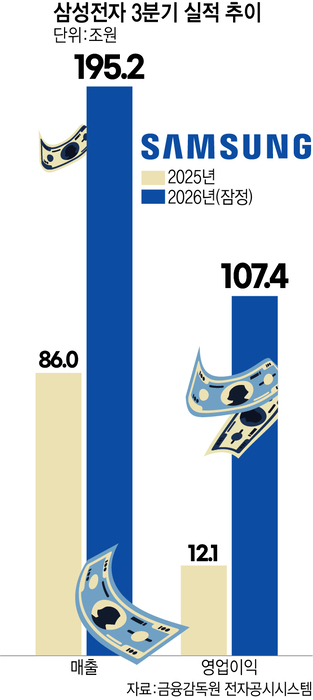
On the 29th, Samsung Electronics reported consolidated Q3 revenue of 195.3 trillion KRW and an operating profit of 10.74 trillion KRW. Driven by increased AI semiconductor demand, it became the first global big tech company to achieve a quarterly operating profit exceeding 10 trillion KRW.
The semiconductor business alone contributed 10.65 trillion KRW to the operating profit, setting new records for both revenue and profit for consecutive quarters.
Overall revenue increased 127% year-over-year, while operating profit surged 783%. Compared to the previous quarter, revenue rose 14% and operating profit grew 20%. The operating margin reached 55.0%, up 2.8 percentage points from the prior quarter.
The DS Division, responsible for semiconductor business, recorded sales of KRW 147.1 trillion, a 344% increase compared to the same period last year, and an operating profit of KRW 106.5 trillion, up KRW 99.5 trillion. The operating profit margin was 72%. Memory business sales surged 427% year-on-year to KRW 140.7 trillion.
Samsung Electronics' Q3 HBM4 sales tripled compared to the previous quarter, accounting for over 60% of HBM sales. The company also achieved its second-half goal of raising HBM market share to match DRAM market share in Q3.
Samsung Electronics forecasted that demand will continue to outpace supply as AI infrastructure investments expand.
Kim Jae-jun, Head of Strategic Marketing at Samsung Electronics' Memory Business Division (Vice President), stated, “For 2027 HBM supply, negotiations at target price levels have been completed, and the volume is already sold out.” This means all 2028 HBM volumes have been sold.
Vice President Kim added, “Tight supply conditions will persist in 2028,” expecting the supply shortage to continue until 2028.
Foundry has also entered a phase where demand exceeds supply. Samsung Electronics anticipates that the utilization rate for processes below 8nm will exceed 100% next year. The number of 2nm orders this year has more than doubled compared to the previous year, and next year, high-performance computing (HPC) sales are expected to exceed 50%. The Taylor, Texas factory has begun cleanroom operations and equipment installation.
Despite strong semiconductor performance, mobile phones and home appliances face different challenges. The operating profit structure concentrated in the semiconductor business remains a task for Samsung Electronics to address.
The DX Division reported an operating loss of KRW 800 billion in Q3, marking consecutive losses for two quarters. Although sales increased due to new foldable products, rising mobile memory costs hindered performance.
Samsung Electronics expects cost pressures in the DX Division to continue next year. For mobile, the company plans to shift product composition toward flagship models, and for TVs, increase premium product ratios to defend profitability.
To share record-breaking performance with shareholders, Samsung Electronics will pay a cash dividend of KRW 4,601 per share (total KRW 30 trillion) in Q3 and use up to an additional KRW 75 trillion for shareholder returns. Specific plans will be finalized at the board meeting in late January next year.
