








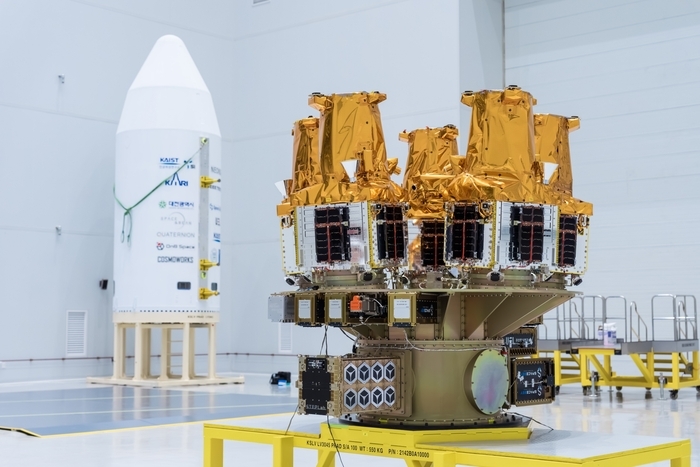
The Ministry of Science and ICT and the Korea Aerospace Research Institute (KARI) held a briefing on the satellites aboard Nuri's fifth launch at the Filwon Center in Gwanghwamun, Seoul, on the 15th.
The miniature constellation satellite “NEONSAT,” developed by KAIST Satellite Research Center in collaboration with KARI and SATRECI, operates as a cluster of satellites under 100 kg. Orbiting at 500-600 km in a sun-synchronous orbit, NEONSAT-2 to -6 will observe the Korean Peninsula more than three times daily. The same location can be reimaged within 24 hours, overcoming the limitations of conventional medium-to-large single Earth observation satellites. Equipped with an electro-optical camera, it captures black-and-white images at 1m resolution and color images at 4m resolution, applicable for disaster monitoring and national security.
Lee Sang-hyun, director of KAIST Satellite Research Center, stated, “The clustered operation enables high-density, high-precision surveillance systems. We expect swift and accurate responses to national security and disaster situations.”
KAIST plans to complete a 10-satellite constellation by launching additional units (7-11) by 2027.
Notable CubeSat missions include SpaceLinQ's “BEE-1012,” which combines a pharmaceutical crystallization chamber with onboard AI. At 570 km in a sun-synchronous orbit, it will study protein and synthetic drug crystallization, with AI analyzing crystal formation and growth stages. This mission tests Alzheimer's disease treatments.
Two satellites will study space radiation. Space&Beyond's “SD-1 SAT” collects South Atlantic Anomaly radiation data using a low-power sensor. KAIST undergraduates developed “GB-SAT” to observe high-energy galactic cosmic rays aligned with Earth's magnetic field.
KARI's “Domestic Component Space Verification Platform-2” will test six payloads, including SK Hynix's DRAM and UFS, high-speed precision mirrors, hollow cathodes for electric thrusters, orbital transfer vehicle avionics testbeds, attitude determination systems, and reaction wheels. The mission assesses radiation and particle effects on memory devices in space.
Next-generation communication technologies will also be tested. Chosun University and Pusan National University's “CPI-SAT” demonstrates laser optical communication and LED-based data transmission between satellites and ground stations.
Satellites for Earth and space observation include O&B Space's “Sledge,” which measures atmospheric refraction, temperature, and pressure using GNSS signals. CosmoWerk's “JACK-007” captures optical Earth images for public use. Quaternions' “PurSat02” analyzes marine debris currents near Jeju Island. The Unmanned Exploration Institute's satellite monitors local fine dust using a domestically developed onboard computer and camera. Daejeon Metropolitan City's “Daejeon-SAT 1” observes urban changes in the Daejeon region.
Park Jae-sung, head of the Space Transportation Division at the Korea Space Agency, stated, “This launch verifies satellites and domestic components in the actual space environment, enhancing Nuri's reliability through repeated launches and expanding Korea's space industry ecosystem.”
