

South Korea's electric vehicle export competitiveness has weakened sharply over the past two years despite rapid growth in the global EV market. If Chinese EVs continue gaining market share, more than KRW2 trillion in Korean EV exports could face competitive pressure by 2030, according to a new analysis.
The Federation of Korean Industries (FKI) released the findings on Nov. 4 in a report examining Korea's EV exports, competitiveness and policy implications.
According to the International Energy Agency (IEA), EVs accounted for 25.0% of global new vehicle sales last year, up nearly tenfold from 2.6% in 2019. That share is expected to reach 29% this year.
Korean-made EVs, however, have lost ground both at home and overseas. Their share of South Korea's battery electric vehicle (BEV) market fell 16.7 percentage points over the same period, from 73.7% to 57.0%. Korea's share of global EV exports also dropped 4.3 percentage points, from 8.9% to 4.6%, declining for two consecutive years after reaching 8.1% in 2023. The report's broader EV analysis covers both BEVs and plug-in hybrid electric vehicles (PHEVs).
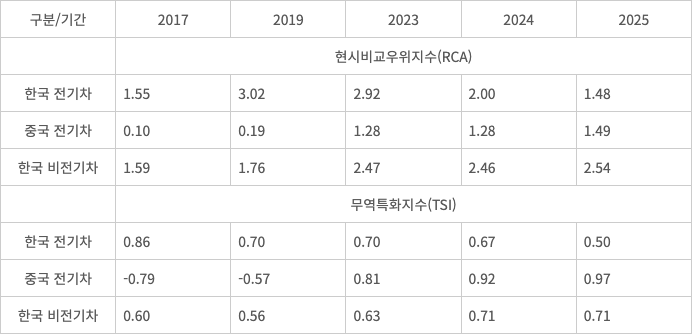
Using UN Comtrade data, the FKI calculated that Korea's revealed comparative advantage (RCA) index for EVs fell from 2.92 in 2023 to 1.48 last year, almost halving in two years. An RCA above 1 indicates a comparative advantage in exports. China's index, just 0.10 in 2017, exceeded 1 in 2022 and reached 1.49 last year, drawing level with Korea.
The two countries also diverged on the trade specialization index (TSI), which measures whether a country is more oriented toward exports or imports in a given product category. China's score stood at -0.79 in 2017, indicating import specialization. It shifted to export specialization in 2020 and reached 0.97 last year. Korea's score fell from 0.70 in 2023 to 0.50 last year.
The trend contrasts with Korea's performance in non-electric vehicles. Over the same period, its RCA in that category improved from 2.47 to 2.54, while its TSI rose from 0.63 to 0.71, highlighting a widening gap in export competitiveness between electric and non-electric vehicles.
The analysis measures export specialization in domestically produced vehicles using national trade data. It does not assess automakers' overall global competitiveness, including overseas production and sales.
The FKI estimated that if China's EV market share continues rising through 2030 at the pace seen over the past two years, approximately KRW2.2 trillion ($1.61 billion) in Korean EV exports would be exposed to competitive risk. That is equivalent to 14.7% of last year's EV export value. Applying an analytical approach used in a U.S. Chamber of Commerce report, the estimate ranges from $1.4 billion to $2.3 billion depending on the base year used to calculate the trend.
Large-scale Chinese government support was also cited as a factor behind the shift in competitiveness. In a report published in July last year, the Massachusetts Institute of Technology (MIT) estimated that subsidies for China's EV and battery manufacturing industries totaled approximately $17.5 billion, or around KRW23 trillion, in 2024.
“China's EV industry is rapidly securing a leading position in the future automotive market, backed by strong government support,” said Lee Sang-ho, head of the FKI's economic research division. “Policy support, including domestic production tax credits, should be considered to expand Korea's EV manufacturing base.”