




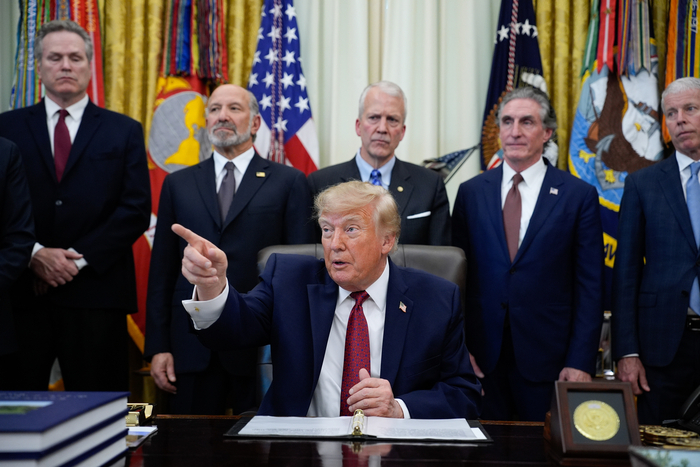
The U.S. Democratic Party has regained control of both the Senate and House of Representatives in the midterm elections, putting a brake on President Donald Trump's late-term governance. While Democrats have warned of comprehensive oversight over key policies, budgets, and appointments, Trump has signaled his intent to counter with vetoes, raising the prospect of a direct clash between the executive and legislative branches.
As of 6:00 AM Eastern Time on the 4th, Democrats secured 54 Senate seats, securing a majority. Republicans trailed with 44 seats. In Mississippi and Alaska, two remaining states, both parties' candidates remain in a tight race as vote counting continues.
In the House, Democrats surpassed the majority threshold of 218 seats, securing 228 out of 435 total seats. U.S. media projected that Democrats could ultimately secure between 244 and 250 seats. This marks the first time in 20 years, since 2006, that the opposition party has simultaneously regained control of both chambers.
Democrats' victory was driven by sweeping competitive states and targeting Republican strongholds. They flipped Senate seats previously held by Republicans in seven states: North Carolina, South Carolina, Texas, Kansas, Ohio, Iowa, and Maine. They also defended key battlegrounds like Michigan and Georgia, which Republicans had aimed to reclaim.
Notably, in traditionally Republican-leaning Kansas and Texas, Democratic senators were elected for the first time in 94 and 38 years, respectively. South Carolina also saw a Democratic candidate win after 28 years. Out of the seven major Senate battlegrounds, Democrats swept six, excluding Alaska where counting remains incomplete.
A similar trend emerged in the House elections. According to Reuters, Democrats won all 20 House districts where results were finalized among the closely watched races. Even in districts where Republicans had redrawn electoral boundaries to gain seats, Democrats retained a significant number, thwarting the GOP's strategic goals.
The Democratic surge extended to gubernatorial races. They flipped governorships in Texas, Georgia, Ohio, and Iowa—states previously held by Republicans—raising the number of Democratic-led states from 24 to at least 28.
This election is interpreted as a judgment on Trump's governance, resonating not only in battlegrounds but also penetrating the Republican Party's traditional base. With Democrats winning both chambers and key gubernatorial races, analysts describe the outcome as a “blue tsunami” beyond a mere “blue wave.”
When the 120th Congress convenes in early January, a confrontation between the Trump administration and the Democratic-led Congress is expected to intensify. Democrats are likely to use their budgetary and legislative authority to block key Trump administration policies, while leveraging congressional investigations and Senate confirmation powers to increase pressure. Investigations into Trump, his family, and close associates may also be pursued.
Unlike the first half of his term, when Trump enjoyed Republican congressional support, he now faces a situation where he must negotiate with Democrats on every major policy initiative. If budgets and legislation stall, his policy momentum could weaken, raising concerns about an early lame-duck period.
However, Democrats also face constraints, including presidential vetoes and Senate filibusters. If Trump aggressively uses executive orders and presidential authority, policy clashes and legislative gridlock could deepen during the remaining term.
Trump, while accepting the election results, hinted at future clashes with Democrats. In an interview with *The New York Times* (NYT), he stated, “I'm fully willing to accept the results. We will work with the Democrats, and I look forward to working with them. We'll probably make some deals.”
However, he distanced himself from responsibility for the defeat. On Truth Social, he wrote, “I was not on the ballot. If I had been, we would have won big.” In a Fox News interview, he reiterated his stance, saying, “(Democrats) are going to send crazy things over, and I'll veto them,” confirming his intent to veto Democratic-led legislation.
Senate Democratic Leader Chuck Schumer, in a press conference, stated, “A generational realignment of the Senate map has now occurred to change America. The American people voted for change, and now Democrats must deliver results.”
