







“Pass me the scissors.”
Upon the lead surgeon's request, a humanoid robot beside the operating table picked up scissors from among several surgical instruments neatly arranged on a tray and handed them to the doctor with the handles facing forward. It took about 5 seconds from picking up the instrument to placing it in the doctor's hand. Receiving the used tool back and placing it in its proper spot took just over 10 seconds.
The other robot across from it simultaneously performed the roles of an assistant surgeon and a nurse. It held a laparoscopic endoscope with one hand to center the surgical area on the screen, while pulling tissue with surgical forceps using its other hand to secure operating space.
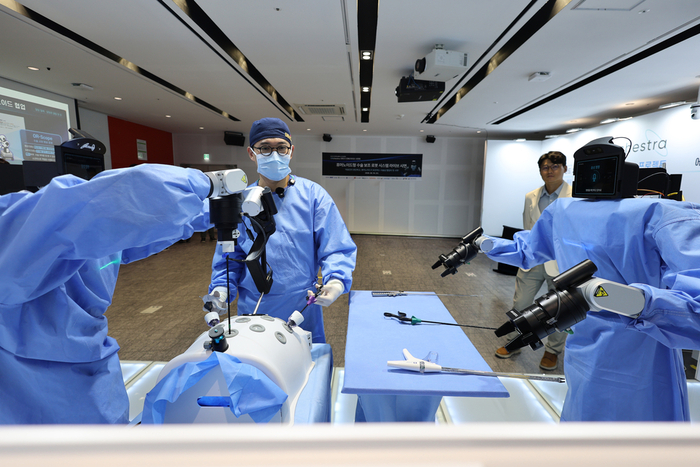
On the 16th, Samsung Medical Center unveiled a humanoid surgical assistant robot under development as part of the ARPA-H project for the first time at Hippocrates Hall near its main hospital in Seoul, demonstrating cystic duct isolation using a goat liver.
This marks the world's first time a medical team and multiple humanoids collaborated to implement a surgical process. On this day, the robots successfully demonstrated performing tasks handled by operating room nurses and assistant doctors, including passing and retrieving surgical tools, operating endoscopes, and tractioning tissue.
Two humanoid robots assigned different roles were deployed for the demonstration. The first robot took on the role of an operating room nurse, recognizing the lead surgeon's voice commands and carrying out the overall circulation task from request, delivery, use, retrieval, to organization of surgical tools.
The other robot acted as both an assistant doctor and a nurse simultaneously. Holding a laparoscopic endoscope with one hand, it tracked the location of surgical tools to adjust the field of vision. To prevent screen shaking even with small movements, it moved the endoscope only when surgical tools left a designated area. With its other hand, it operated surgical forceps to maintain tissue in a designated direction.
A scene was also revealed where a human remotely controlled a robot performing incision, dissection, and suturing maneuvers. As the lead surgeon moved arms and hands while watching a monitor, the robot replicated the movements in real time. It is a method of precisely controlling both arms and surgical tools by translating human motion into robot coordinates.
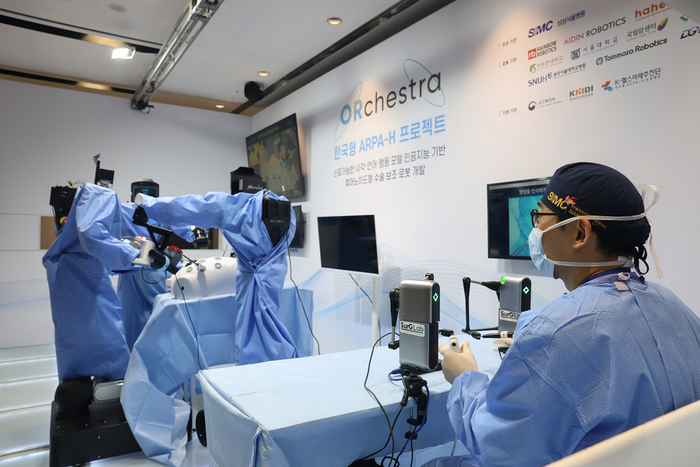
The humanoid surgical assistant robot presented on this day is the initial outcome developed after being selected for the K-ARPA-H project supported by the Ministry of Health and Welfare and the Korea Health Industry Development Institute's K-Health Future Initiative. Samsung Medical Center led the project, with Rainbow Robotics, Aidin Robotics, Sungkyunkwan University, Seoul National University, the National Cancer Center, and Jeonbuk National University Hospital participating as the “Orchestra Consortium.” Government research and development funding of KRW13.835 billion will be invested over 54 months until late 2029.
In laboratory evaluations, the surgical robot successfully grasped all 5 types of surgical instruments. The tool delivery success rate recorded 98.7%. Voice command recognition rates and task execution success rates surpassed the phase 1 goal of 95%.
The humanoid surgical assistant robot adopted a wheeled mobile base instead of bipedal locomotion for safety and precision. Existing facilities and instruments can be used as they are without needing to completely replace operating room workflows and designs for the robot.
Jeong Yong-gi, professor of otorhinolaryngology at Samsung Medical Center who serves as chief principal investigator, said, “This will resolve practical problems where emergency surgeries cannot be handled in a timely manner due to a lack of surgical assistant staff caused by resident work hour limits and manpower shortages,” adding, “The project group plans to look into legal and institutional issues as well so that working conditions for humanoid robots in operating rooms can be prepared in advance.”
Samsung Medical Center aims to conduct its first clinical trials in 2029. It plans to start with sequential application to low-risk tasks such as endoscope holding and laparoscopic vision adjustment, subsequently expanding application areas to tissue traction and other procedures.
Jeong said, “Korea possesses high medical standards, excellent AI technology, research staff, and highly reliable security systems, making it a field where we can take a significant lead if investment precedes,” adding, “Once development is completed successfully, the return on investment (ROI) will also be substantial.”
