




Rising Raw Material Costs Add Pressure
Fourth-Quarter Production to Be Reduced
Shift Aims to Boost Profitability

Samsung Electronics plans to cut fourth-quarter production of its midrange and budget Galaxy A smartphones by approximately 20% from its original target. Amid chipflation and difficulties securing raw materials, the company is shifting its strategy toward reducing production of lower-priced smartphones and concentrating resources on flagship models.
According to industry sources on Oct. 25, Samsung Electronics has notified its supply chain of a plan to reduce Galaxy A series production volumes.
“Component orders for the fourth quarter have declined by approximately 20% compared with the production plan established earlier this year,” an industry source familiar with the matter said. “On an annual basis, that translates into a reduction of approximately 10 million units.”
Another industry source said, “Samsung Electronics' Mobile eXperience (MX) Business is facing an emergency situation after recording losses this year. The company is also moving toward reducing Galaxy A series production by more than 10% next year.”
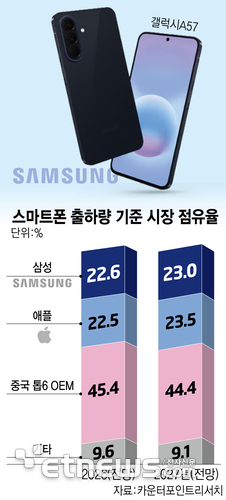
Samsung Electronics ships approximately 230 million to 240 million smartphones annually. The company has been competing closely with Apple for first and second place in the global smartphone market by shipment volume. The Galaxy A series, its midrange and budget lineup responsible for a substantial share of shipments, has played a major role in that competition. Accounting for 70% of Samsung's smartphone shipments, the Galaxy A series has served as the company's main driver in the battle for global market share.
Chipflation and rising raw material prices are behind the production cuts. As memory chip prices have risen sharply, memory semiconductors have come to account for more than half of the production cost of some midrange and budget smartphones.
In addition, raw materials for key components, including printed circuit boards (PCBs) and multilayer ceramic capacitors (MLCCs), are being prioritized for higher-value-added artificial intelligence (AI) semiconductors, making it difficult to secure supplies for smartphones.
Samsung Electronics has maintained relatively stable Galaxy A production and defended its market share despite chipflation, benefiting from a stronger position in securing raw materials than Chinese smartphone manufacturers. However, as chipflation and raw material shortages persist, the company is believed to have concluded that concentrating components and raw materials on higher-margin flagship products, such as the Galaxy S series and Galaxy Z foldable smartphones, would be more effective in securing profitability than maintaining production of the less profitable Galaxy A series.
Samsung Electronics' decision is drawing attention because it comes amid intense competition with Apple for the top position in global smartphone shipments. In August, Counterpoint Research forecast that Samsung Electronics would rank first in the global smartphone market this year, edging out Apple by 0.1 percentage point. With such a narrow margin, however, Samsung could still fail to reclaim the top spot.
Concerns are also growing that consumers could face a greater financial burden if chipflation and difficulties securing raw materials continue.
“If production volumes decline, smartphone launch prices could increase,” an industry official said. “New smartphones could also be released at higher prices despite being equipped with downgraded components, such as displays or cameras.”
