








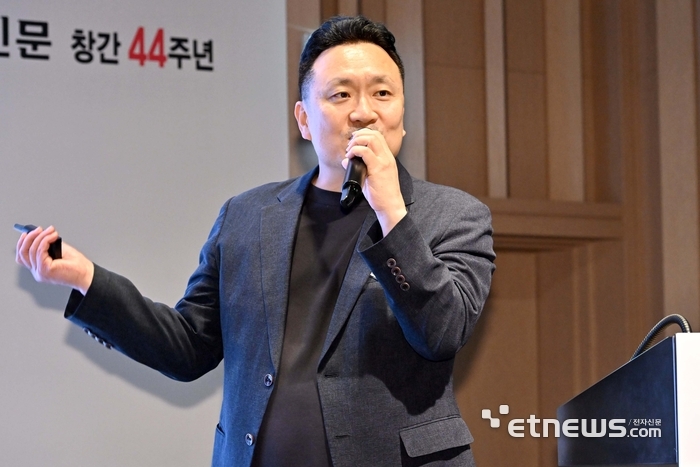
Corporate AI transformation is moving beyond technology adoption to the stage of practical application in daily operations. As AI evolves into agents that directly perform tasks, companies are addressing solutions for the “execution phase,” including data protection, security, task-specific AI implementation, cost reduction, and private AI infrastructure.
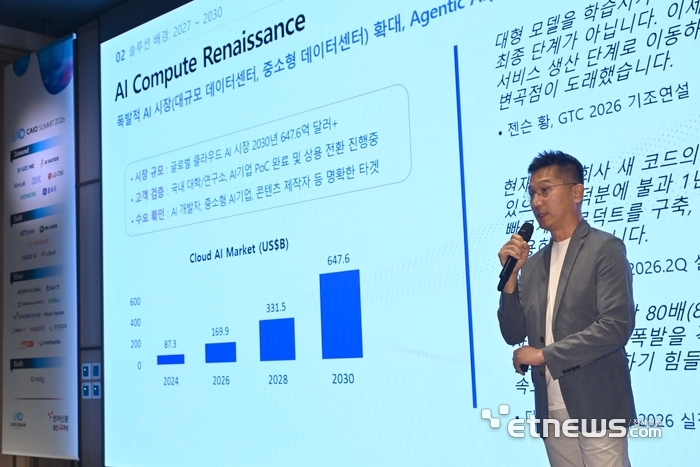
Yang Jung-mo, Managing Director of Aicloud, stated at the 'CAIO Summit 2026' on the 18th in Seoul, “Previously, multiple GPUs were required to run advanced AI models, but now even small models can handle diverse tasks.”
He added, “Enterprises and institutions can now cover repetitive daily tasks with the latest Small Language Models (SLMs)” and introduced strategies for building private AI infrastructure to operate AI internally.
Aicloud proposed 'NeoCube,' a modular AI data center that integrates GPUs/NPUs, servers, storage, power, cooling, and AI management platforms. NeoCube virtualizes GPU/NPU resources and supports the deployment and operation of AI models like LLMs.
As AI adoption expands, utilizing internal data and ensuring security have become critical challenges. Since AI directly accesses work-related data such as internal documents and emails, companies must balance productivity with robust data protection and control systems.
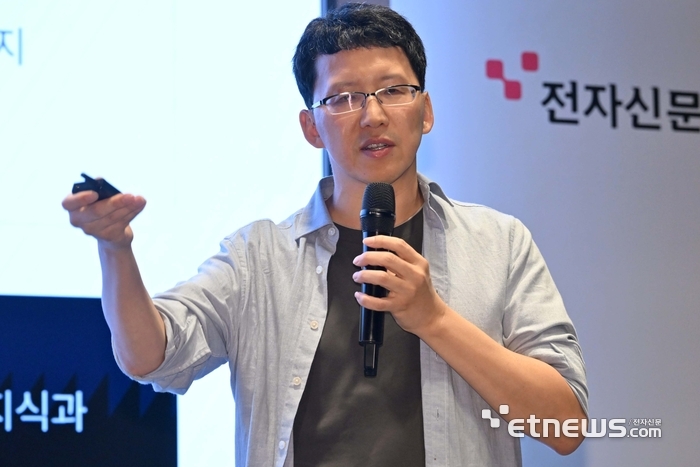
Park Jong-cheon, Chief AI Officer (CAIO) of Jiranjigyo Soft, emphasized, “As AI evolves beyond answering questions to performing actual tasks as agents, the way companies work must fundamentally change. We must shift from individual productivity to organizational productivity and transform from organizations using AI tools to organizations where AI works.”
Jiranjigyo Soft stressed the need to combine “OfficeAgent,” which performs tasks, with “OfficeKeeper,” responsible for information protection, to implement both an AI work environment and security. Their vision is to connect work data such as documents, emails, and messengers with AI while simultaneously establishing a security framework to prevent leaks of personal and confidential information.
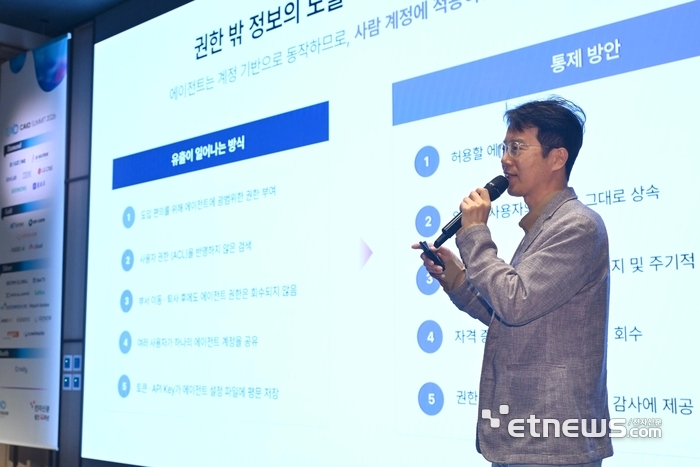
Fasoo AI diagnosed that in the AI agent era, protecting corporate information with existing security systems alone is insufficient.
Choi Woo-sun, head of Fasoo AI's team, explained, “AI security is not a problem that can be solved with a single solution; it must be addressed across multiple layers—from data protection to access paths, tools, supply chains, visibility, and governance.”
To achieve this, Fasoo AI proposed a strategy of dividing AI security into a multi-layered structure and deploying tailored solutions for each domain.
Fasoo AI constructed a security framework in stages, from identifying sensitive information to controlling AI data access paths, managing internal system integrations, and monitoring AI usage. Notably, through 'Fasoo AI Radar,' they detect unauthorized AI usage and manage security policies, data leak prevention, and cost control in a single platform.
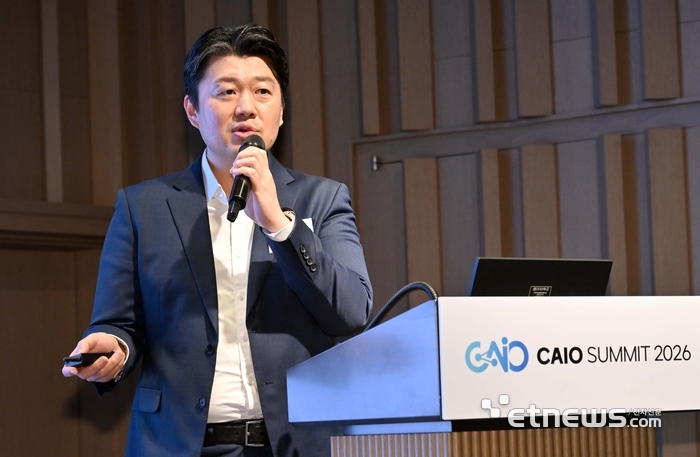
Daol TS emphasized the importance of first verifying AI's effectiveness at the task level rather than applying it across the entire organization from the start.
Kim Jung-hee, director of Daol TS's AI Architecture Team, advised, “The success of AI adoption depends not on scale but on sequence. Start with one core task, prove its effectiveness, and then expand.”
Daol TS introduced “Daol Fusion,” an integrated package that supports this phased AI adoption. It is a solution that bundles AI infrastructure and verified solutions, enabling enterprises and institutions to seamlessly progress from proof of concept (PoC) to task-level AI implementation and subsequent server-based infrastructure expansion within a single system.
Daol TS also supports verifying actual applicability and required equipment scale in advance through its own validation environment.
Solutions to reduce costs for graphics processing units (GPUs) required for AI computations were also presented.
Data Alliance introduced 'gCube,' a distributed GPU service that connects scattered GPUs across public clouds, corporate/university/research institute servers, PC cafes, and personal PCs. The platform aims to reduce large-scale equipment investments and usage costs by sharing underutilized GPUs through an economy-of-sharing model, lending idle resources where needed.
Jeong Jin-hwan, Vice President and CTO of Data Alliance, stated, “Without owning dedicated GPU equipment, various idle GPUs can be utilized as resources,” adding, “This approach can reduce GPU usage costs by up to 90% compared to hyperscalers.”
