








MOTIE to Support Anchor Company's Ultra-Gap Tech
Photo-Patterning Applied Without FMM
Advantageous for High Brightness and Low Power
Securing Process Tech and Emissive Materials Key
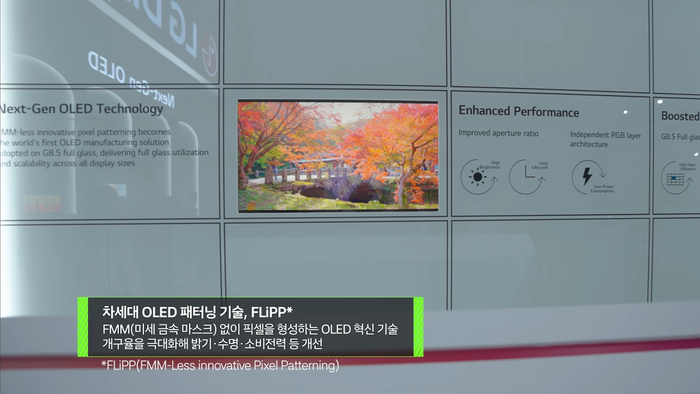
The South Korean government will pursue LG Display Co.'s next-generation organic light-emitting diode (OLED) technology “FLiPP”—which does not use fine metal masks (FMM)—as a national research and development (R&D) project. The aim is to lead a technological ultra-gap by developing strategic technology together with an anchor company in the display industry.
According to industry sources on Sept. 27, the Ministry of Trade, Industry and Energy (MOTIE) is planning the “8th-Generation Photo-Patterning Technology and High-Efficiency, Long-Life Element Development for Securing Next-Generation OLED Industrial Competitiveness” project as a new candidate support project for 2027.
The goal is to develop core “photo-patterning” processes for high-resolution, large-area OLEDs and next-generation OLED light-emitting materials to lead all OLED product markets, including laptops, tablets, and TVs. The project will run for four years starting in 2027, with the support size expected to be around KRW100 billion.
Since OLED is a national strategic technology, there are many cases where materials, components, and equipment companies develop technologies and large corporations verify them. However, it is rare to designate a specific large enterprise as an anchor company and conduct a project tailored to that company's business direction under corporate leadership.
The biggest feature of this project is that the government is supporting the development of photo-patterning technology (FLiPP), a non-FMM technology and one of LG Display's new OLED technologies, through R&D policy.
Lee Min-woo, director general at MOTIE, said at the 17th Display Day commemoration ceremony held on the 17th of this month, “Through the 'Growing Together Project' that organically links large, small, and medium-sized enterprises, we will secure FMM-less (non-FMM) technology, a next-generation process technology, to open a world-first path.”
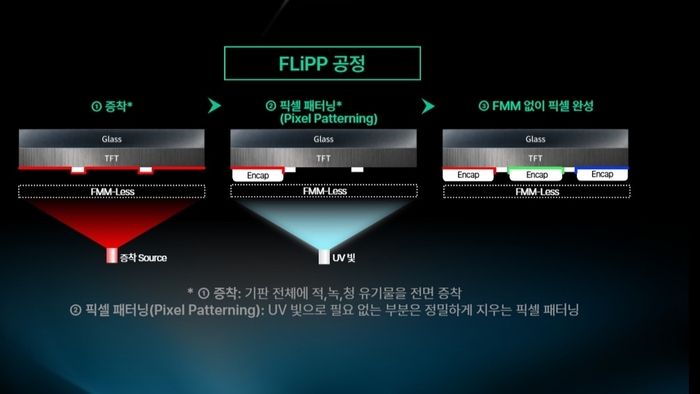
Photo-patterning technology is a method of depositing organic materials across the entire substrate and then removing unnecessary pixel areas through an exposure process. This is one of the red, green, and blue (RGB) OLED pixel-forming technologies that does not use FMM. LG Display calls this technology “FLiPP.”
Compared to FMM OLEDs, it can maximize the aperture ratio (the area occupied by pixels in the entire display), making it advantageous for achieving high brightness and low power consumption. It can reduce residual organic matter left on the FMM after deposition, and because it does not require expensive FMM deposition equipment, capital expenditure costs are relatively low.
While FMM panels can only be mass-produced up to the mid-10-inch range, the photo-patterning method has no panel size restrictions, making it an advantage that panels from ultra-small to medium and large can be manufactured with RGB OLEDs.
The key is securing process technology and light-emitting materials suitable for the new process. The photo-patterning method is evaluated as a technology in which the weakness of OLEDs, which are vulnerable to moisture and oxygen, is highlighted. For this reason, securing reliable and durable light-emitting materials and encapsulation process technology is considered essential.
A display industry official said, “Since LG Display needs to conduct research and development and capital investment simultaneously, significant financial resources are required,” adding, “This project will be able to lighten the burden of R&D funding.”
LG Display plans to use an existing line located at the P8 plant in its Paju facility as a dedicated line for FLiPP. The plan is to build an 8th-generation IT OLED line that can mass-produce medium and large RGB OLEDs as quickly as possible by utilizing existing lines to the maximum extent.
