








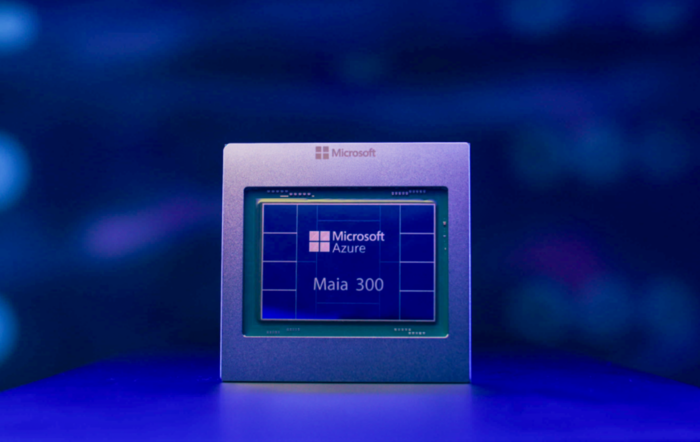
Microsoft has officially taken the wraps off its third-generation custom artificial intelligence silicon, the Maia 300, aiming to deploy more than one million units starting next year to reduce its reliance on Nvidia.
According to reports from Reuters and other media outlets on Oct. 12 (local time), the tech giant plans to scale its in-house Azure Maia infrastructure into multi-gigawatt capacities, anchoring it as the primary inference backbone for its flagship AI products and services. Deployments of the Maia 300 are projected to surpass the one-million-unit milestone within the next year.
Scott Guthrie, Executive Vice President of Cloud and AI at Microsoft, highlighted the shift, stating that the industry is entering a new infrastructural phase geared for the superintelligence (SI) era. He noted that the Maia 300 will process 40% more tokens per megawatt than leading GPU-based systems, though specific baseline hardware comparisons were not disclosed.
Under the hood, the Maia 300 employs an advanced multi-chiplet architecture. The primary compute tiles are fabricated on TSMC's cutting-edge 2-nanometer (2nm) process, while the auxiliary chiplets handling I/O and data transport leverage a 3-nanometer (3nm) node.
Each processor is equipped with eight sixth-generation high-bandwidth memory (HBM4) stacks, delivering a massive memory bandwidth of 18 terabytes per second (TB/s) alongside a thermal design power (TDP) rating of 950 watts (W).
At the rack level, an enclosure housing 96 accelerators consumes approximately 167 kilowatts (kW) of power while delivering up to seven times the overall throughput of its predecessor, the Maia 200. By comparison, Nvidia's flagship GB300 rack draws roughly 142 kW across 72 GPUs.
The previous-generation Maia 200, introduced this past January, is currently deployed across Microsoft Copilot workloads, with integration set to expand into GitHub Copilot and other services by the end of the year.
Rival hyperscalers including Google and Amazon are likewise accelerating proprietary AI chip initiatives, pursuing dual goals of expanding infrastructure while diversifying beyond an Nvidia-dominated supply chain.
Microsoft's capital expenditure (CapEx) for this year is projected to exceed KRW233,695,000,000,000 ($175 billion). The company plans to share additional details on its silicon roadmap at its annual developer conference, Ignite 2026, in San Francisco next month.
