







Starting this month, a new system will be introduced where buyers of electric vehicles (EVs) pay only for the vehicle body, excluding the battery cost. The battery will be used by paying a monthly subscription fee (lease fee) to a capital company, and a new insurance contract model will apply, distinguishing between the vehicle body and battery.
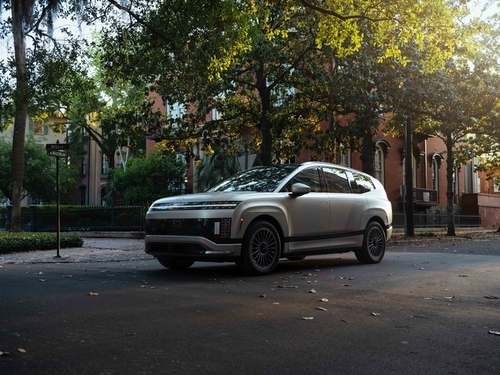
According to financial industry sources on the 14th, a battery subscription pilot project will begin this month for the Ioniq 5, 6, and 9. The battery value is set at 17 million KRW for the Ioniq 5 and 6, and 22 million KRW for the Ioniq 9.
This project follows the 'Battery as a Service (BaaS)' model, where consumers pay usage fees instead of purchasing the battery outright. Previously, individuals owned both the vehicle body and battery when buying an EV, but under BaaS, the individual owns only the vehicle body, while the battery is leased by the capital company.
Although the initial vehicle purchase price becomes 17-22 million KRW cheaper, buyers will pay monthly battery usage fees to Hyundai Capital after purchasing the vehicle.
The Ministry of Land, Infrastructure and Transport permitted regulatory exceptions in May to introduce the battery subscription service and plans to verify the project targeting 2,000 EVs over the next two years. The ministry previously stated that battery costs account for about 40% of an EV's price. Going forward, the high cost of batteries will no longer be a barrier to EV adoption, as they won't need to be purchased with the vehicle body.
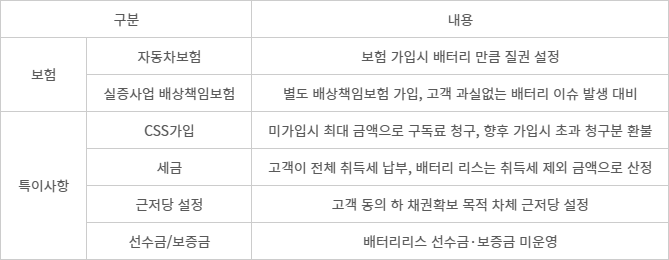
With the separation of ownership between the vehicle body and battery, a new insurance contract structure will apply. EV buyers will still insure the entire vehicle, including the battery, and pay the same premium. However, if the battery is totally damaged, a security interest (lien) will be set on the insurance claim right to ensure the capital company receives the insurance payout.
A security interest is a mechanism that secures the right to receive insurance payouts as collateral. The amount of the lien is set at 17 million KRW for the Ioniq 5 and 6, and 22 million KRW for the Ioniq 9, equivalent to the battery's value, allowing the capital company to claim that portion of the insurance payout.
The capital company will also establish a mortgage on the vehicle body owned by the customer after obtaining consent. This measure is to address cases where subscription fees are not paid, and the mortgage amount varies depending on the customer's credit rating. No separate deposit or security is required for the BaaS service.
The acquisition tax will still be calculated based on the total vehicle price, including the battery, as before. However, the subscription fee will be designed to exclude the acquisition tax. The capital company must also subscribe to a separate liability insurance policy to cover battery accidents not caused by the customer's fault.
The Ministry of Land, Infrastructure and Transport and Hyundai Motor plan to determine the appropriate subscription fee based on the results of this pilot project. If the customer does not subscribe to Hyundai's Connected Car Service (CCS), the maximum subscription fee will be charged first, and the excess amount will be refunded if they subscribe later. Customers who do not subscribe to CCS will continue to receive guidance on enrollment.
An insurance industry official stated, “As battery ownership is separated, the insurance subscription structure must also change,” and added, “Guidance has been provided for the pilot project on separated EV ownership to prevent confusion at the insurance subscription stage.”