




The South Korean government is set to initiate a comprehensive rollout of next-generation telecommunications infrastructure—including AI-Radio Access Networks (AI-RAN)—across mission-critical public domains such as education, defense, healthcare, and emergency response starting next year. By modernizing public sector connectivity, the initiative seeks to validate advanced services such as physical AI, ultimately priming the pump for nationwide AI transformation (AX).
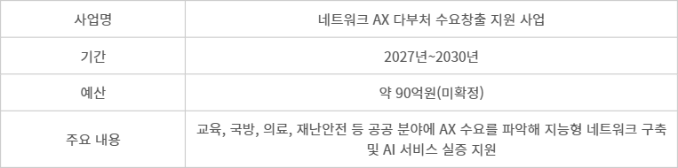
According to government sources on Oct. 18, the Ministry of Science and ICT (MSIT) plans to launch the “Inter-Ministerial Demand Generation Initiative for Network AX” in 2027 to overhaul network infrastructure across public agencies. Once the budget allocation is finalized next month, contractors and technology partners will be selected in early 2027.
At its core, the project focuses on deploying high-performance intelligent networks and validating live AI services across key public interest sectors. Through this intervention, the government aims to stimulate early domestic demand for AI-optimized network equipment while helping local hardware and solution providers build proven commercial track records.
MSIT has designated public bodies overseeing education, national defense, healthcare, and disaster management as priority targets. These agencies manage operations vital to public safety and daily life, yet frequently face bottlenecks when adopting advanced AI workloads due to aging network legacy infrastructure. MSIT and the National Information Society Agency (NIA) have already begun conducting baseline demand assessments across target ministries, including the Ministry of Education, the Ministry of National Defense, the Ministry of Health and Welfare, and the Ministry of the Interior and Safety.
Once the specific AX requirements of each agency are identified, tailored network deployments will commence to support their designated AI applications. Eligible network architectures encompass commercial and near-commercial 5G technologies—such as Private 5G, 5G-Advanced, 5G Standalone (SA), network slicing, and AI-RAN. In tandem with network construction, the program will fund and facilitate field trials of agency-requested AI services, spanning physical AI, autonomous AI agents, and augmented reality (AR) smart glasses.
The project will run for four years, from 2027 through 2030. The government plans to select three initial projects next year, backed by a combined KRW9 billion over a two-year timeline, before selecting two to three additional projects in subsequent phases.
“The public education sector, for instance, still depends on legacy setups like conventional Wi-Fi and LTE, which face severe throughput and latency constraints when powering resource-intensive AI services,” an MSIT official stated. “By actively pinpointing these operational bottlenecks across public services, building intelligent networks, and validating live AI deployments, this project will serve as the initial catalyst for comprehensive public-sector AX.”
MSIT envisions the project as a critical turning point to accelerate institutional AI transformation through network modernization. While the private sector has aggressively pursued AX to drive business innovation, reduce overhead, and maximize operational throughput, public institutions have progressed at a slower pace due to organizational rigidity and heightened security constraints.
Domestic network equipment manufacturers have also welcomed the government-led initiative. In recent years, enterprise capital expenditure has been heavily directed toward software-level AI models. Against this backdrop, public sector commitments to build dedicated physical infrastructure and validate field-ready AI services are expected to unlock fresh demand across the domestic telecom equipment supply chain.
