




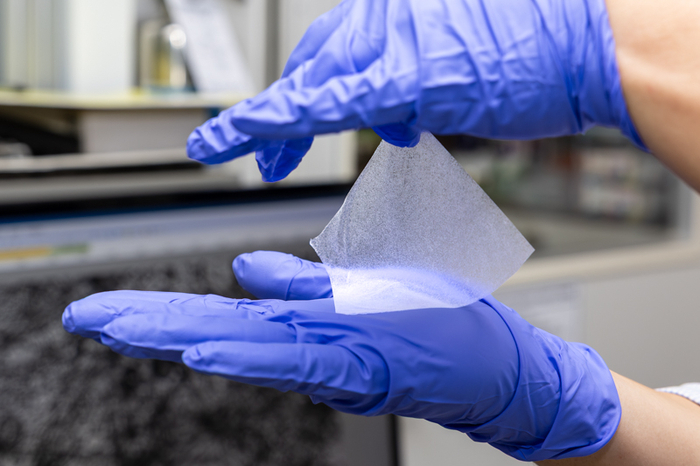
Researchers have developed a one-step spray process that simultaneously forms fibers and applies a protective coating. The technological breakthrough is expected to streamline the manufacturing of self-powered smart devices capable of detecting handwriting and button inputs without external batteries.
The Korea Research Institute of Chemical Technology (KRICT, President Seok-min Shin) announced on Oct. 19 that a joint research team—led by Dr. Eun-ho Son and Dr. Joo-hyun Kim alongside University of Science and Technology [UST] professors, and Prof. Jin-woo Bae of the School of Energy, Materials and Chemical Engineering at the Korea University of Technology and Education (KUT)—has successfully fabricated self-powered fibers through simple spray coating, eliminating the need for high-voltage equipment.
To increase the power generation of Triboelectric Nanogenerators (TENGs), expanding the contact area and preventing electrical leakage are essential. While ultra-fine polymer fibers facilitate this, traditional fabrication methods required complex steps—such as spinning fibers using high-voltage equipment followed by an additional anti-leakage coating—making large-scale manufacturing difficult.
To overcome this hurdle, the research team developed a single-step spray process combining a fluorine-based polymer with high electron affinity, P(VDF-TrFE), and a silicone-based polymer adept at retaining charge, PDMS.
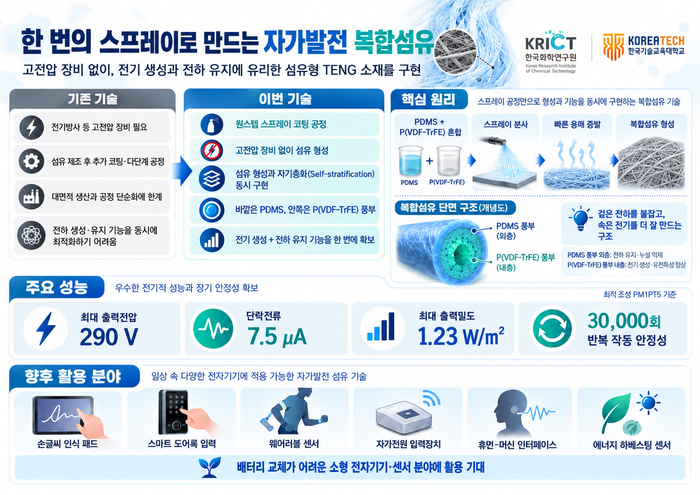
Performance evaluations showed a voltage of 290 volts (V), a current of 7.5 microamperes (μA), and a maximum power density of 1.23 watts per square meter (W/m²), levels sufficient for powering small electronic device sensors. Furthermore, the material demonstrated exceptional durability, maintaining initial output performance even after 30,000 touch-and-separation cycles.
The team utilized the material to build a keypad comprising 12 TENG sensors, which was then integrated into a smart door lock prototype. This confirmed that the newly developed material can function effectively not only as an energy harvester but also as a self-powered interface sensor.
“This research is expected to help simplify the manufacturing processes for large-scale self-powered sensors and wearable electronic devices,” said Prof. Jin-woo Bae of KUT. KRICT President Seok-min Shin added, “This is a prime example of how KRICT's long-standing expertise in fluorine-based materials—a field with few domestic research institutions—can be applied across diverse applications.”
The findings were published last month in Advanced Composites and Hybrid Materials. Dr. Eun-ho Son and Dr. Joo-hyun Kim of KRICT alongside Prof. Jin-woo Bae of KUT served as co-corresponding authors, while Chae-rin Park (a master's student at UST) and In-sun Woo (a Ph.D. candidate at KUT) participated as co-first authors.
