




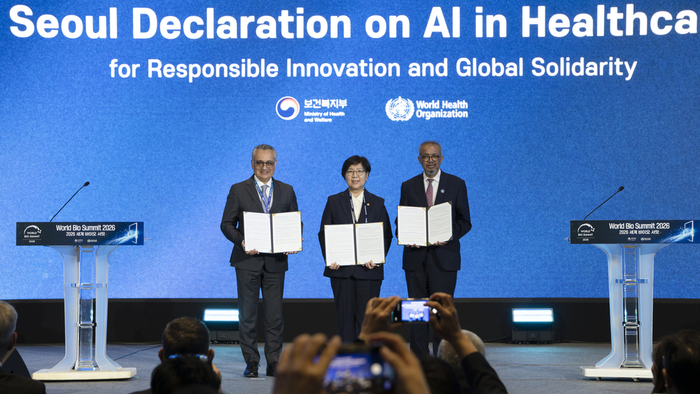
South Korea and the World Health Organization (WHO) are strengthening international cooperation to ensure that the benefits of artificial intelligence (AI) innovation in healthcare are available to everyone, regardless of country or socioeconomic status. To this end, they jointly announced the Seoul Declaration on AI Healthcare, establishing improved access to healthcare and the safe, responsible use of AI as shared principles.
Jung Eun-kyeong, South Korea's minister of health and welfare, and Tedros Adhanom Ghebreyesus, director-general of the WHO, unveiled the Seoul Declaration on AI Healthcare for Responsible Innovation and Global Solidarity at the World Bio Summit 2026, held at COEX Magok Convention Center in Seoul on Oct. 21.
The declaration's central objective is to improve equity in healthcare access so that the benefits of AI innovation are not concentrated in particular countries or socioeconomic groups. It establishes the principle that AI must be used ethically and responsibly while safeguarding human safety and dignity. It also acknowledges that countries differ in their readiness to apply medical AI in clinical settings and achieve meaningful results.
Another significant aspect of the declaration is that it broadens the goals of medical AI development beyond technological advancement and wider adoption to include reducing healthcare disparities and ensuring the equitable sharing of benefits. Recognizing the changes AI could bring to healthcare systems, the declaration sets out the principle that the benefits of innovation should translate into actual opportunities for patients to receive treatment and improvements in their health.
The declaration consists of four areas: technology and investment; AI accountability and risk management; global cooperation and health security; and implementation and follow-up measures.
The International Hospital Federation (IHF) also expressed support for the declaration. Henry Gallardo, president of the IHF, delivered remarks endorsing the initiative and called for action and solidarity from the international community.
“Public trust cannot be earned through declarations alone,” Tedros said. “The responsible use of AI and the establishment of scientific evidence are necessary for the widespread adoption of AI technology.”
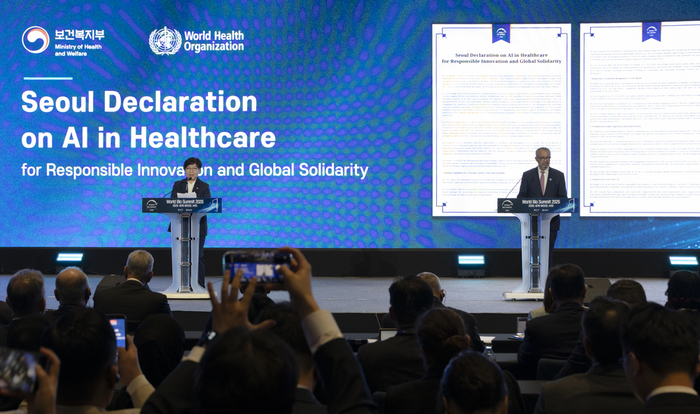
“This is a historic commitment to put human life and dignity first, realize 'AI-powered essential healthcare' and stand in solidarity with the international community,” Jung said. “We will continue to lead responsible AI innovation and take the initiative to ensure that the benefits of AI advancement can be shared by all.”
