

Restructuring is hitting Europe's home appliance industry hard. Longtime leaders such as Electrolux, Miele and Bosch have been cutting jobs and moving production out of the region. Appliances made in Europe now hold a market share of just over 70%.
As local players falter, Korean and Chinese companies are gaining share in Europe. They include Samsung Electronics, LG Electronics, Haier and Midea.
◇European appliance makers in restructuring
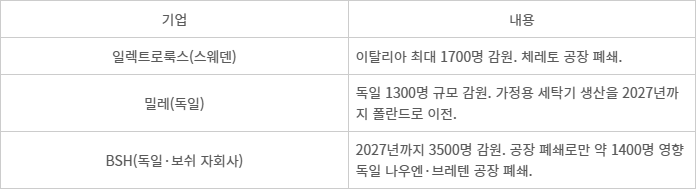
In May, Electrolux announced a restructuring plan for Italy. It would cut up to 1,700 of its 4,500 local jobs and close its Cerreto d'Esi plant. A local metalworkers' union demanded the plan be withdrawn, saying 730 jobs would be lost at just two plants, Susegana and Porcia. The union warned that production of mid- and low-priced refrigerators would shift to China.
Earlier, Miele cut 1,300 jobs in Germany by the end of last year. It will move all of its household washing machine production to its plant in Poland by 2027. BSH, Bosch's home appliance subsidiary, plans to cut 3,500 jobs by 2027. Last October, it announced the closure of two German plants, in Nauen and Bretten, which employ about 1,400 people.
According to Home Appliance Europe (APPLiA), the share of appliances sold in Europe last year that were made in the region fell from the 80% range to 71%.
The trade group blamed the decline on cost structure rather than technology. Industrial electricity prices at European factories are two to three times those of major competitors. Labor and raw material costs are also rising. APPLiA warned that Europe's 80 billion euro manufacturing base is under strain.
◇Korean and Chinese brands gain ground
Korean and Chinese companies continue to grow in the European market. Korean companies have taken an early lead in the premium segment. Samsung Electronics ranked first in Italy's overall appliance market in 2022, including freestanding and built-in products, based on GfK sales data. LG Electronics is expanding its business with the goal of becoming Europe's top appliance maker by revenue by 2030.
Both companies plan to keep launching premium and built-in products tailored to Europe, along with smart home solutions and appliances with energy efficiency ratings of A or higher.
Chinese companies are using the low- and mid-priced segments as a foothold to move into premium products. This year they also got a boost from the heat wave. Chinese air conditioner exports to the EU rose 43.2% in the first half to $3.76 billion. Haier says its European sales grew 4.9% in the first half, and its share of the multi-door refrigerator market by sales exceeded 30% in Spain and Italy.
Europe is a market that Asian appliance makers cannot afford to miss. Barriers to entry are lower than in the U.S., where tariff burdens have grown. Demand for high-efficiency products is also strong. APPLiA data show that the number of appliances with an A or B energy rating in use was 4.4 times the 2020 level as of last year.
“The more European production shrinks, the fiercer the competition between Korean and Chinese companies is likely to become,” an industry official said. “Chinese firms are building technology and design capabilities by acquiring European brands, so even the premium segment is not safe. The gap in energy-efficiency technology and local production strategy will decide the outcome.”