





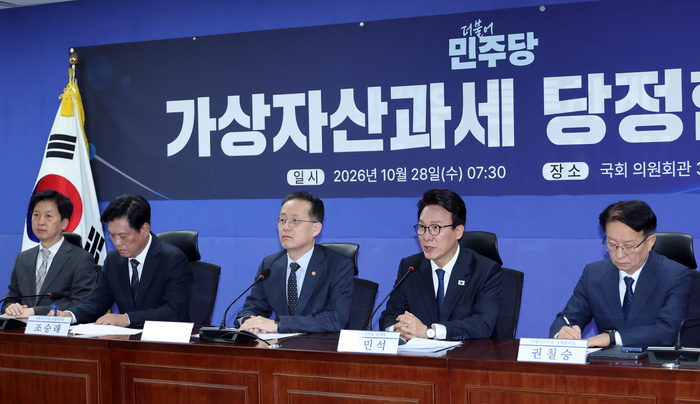
South Korea's ruling Democratic Party and the government discussed whether to delay the crypto tax scheduled to take effect in January but failed to reach a conclusion. The party plans to further review issues including tax fairness and tax infrastructure, then make a final decision on implementation after additional consultations with the government.
“Many said it would be desirable to put the tax on hold for a period of time after reforming and supplementing the rules governing virtual assets,” Democratic Party leader Kim Min-seok said on Wednesday at a Supreme Council meeting at the National Assembly. “We will gather public opinion and, after final discussions with the government, reach a reasonable outcome.”
At the party-government meeting held the same day, participants agreed on the need to implement the tax but said the system must be improved first. According to reports, one side argued that the tax can no longer be postponed after three delays, while the other said the tax framework and market conditions must be reviewed.
Rep. Oh Ki-hyung, the ruling party's lead member on the National Assembly's Strategy and Finance Committee, said after the meeting that “some argued for imposing the tax, while others wanted to address a few more issues.” “The party will conduct a further review,” he added.
The main sticking points are tax fairness between domestic and overseas platforms, access to data from overseas exchanges and tax infrastructure. “Information from domestic exchanges can be collected immediately once the system is in place, but questions were raised about how to obtain data from overseas exchanges,” Oh said. Participants also discussed how to classify crypto derivatives for tax purposes and whether to allow loss carryforwards.
Some also raised the need to enact a Basic Act on Digital Assets to establish the institutional foundation for the crypto market. “There were views that the bill should be passed this year or next,” Oh said.
Kim said taxation is a task that must be pursued under the principle that income should be taxed appropriately, but he noted that the Basic Act on Digital Assets has yet to be enacted. “We need to look comprehensively at inadequate tax infrastructure, fairness with overseas exchanges and concerns among young people who have been trying to build wealth,” he said.
Deputy Prime Minister and Finance Minister Lee Hyung-il said the government is carefully considering “a reasonable plan that the public can accept and that can be implemented reliably on the ground.”
The crypto tax regime was established in 2020 but has been postponed three times. Unless another delay is approved, gains from the sale or lending of virtual assets will be taxed starting in January. Under current rules, a 22% rate, including local income tax, applies to annual income after a basic deduction of 2.5 million KRW.
The Democratic Party also discussed the issue at a general meeting of its lawmakers on Tuesday and plans to decide on a delay after gathering more opinions. Implementing the tax without reforms could cause confusion among taxpayers and spark fairness disputes. A further delay, however, could raise concerns about policy consistency and tax equity, so debate within the party is expected to continue.
