


Amid growing AI-driven hacking threats, a major Japanese bank has begun recruiting teams of bank network security patch developers in South Korea. As the domestic financial sector urgently strengthens its security infrastructure, overseas financial institutions are also seeking developers in Korea, making the securing of core defense personnel an immediate priority.
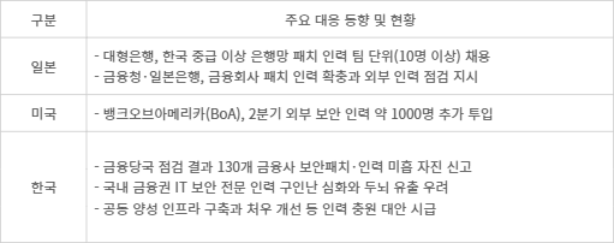
According to financial industry sources on the 29th, a major Japanese bank was confirmed to be recruiting personnel for developing security patches for banking systems in South Korea.
A source familiar with the matter stated, “The bank recently proceeded with hiring over 10 mid-level or higher developers,” adding, “This can be seen as a team-level recruitment effort.”
The source further explained, “These personnel differ from security monitoring staff who oversee external intrusions. They directly operate the bank's IT systems, apply patches, and conduct pre-verification and analyze potential disruptions to ensure uninterrupted transactions—making them high-level talent that cannot be cultivated quickly.”
In Japan, following the public disclosure of critical vulnerabilities in PHP (used for website development) on the 21st-22nd, government agencies and financial companies successively halted some online services and initiated emergency patching. Once vulnerabilities are exposed, attacks can follow immediately, forcing banks to prioritize patching even at the cost of service interruptions.
AI-powered hacking has recently emerged as a global issue. Anthropic's AI model, Mistral, is known to rapidly identify software vulnerabilities that were previously difficult to detect.
Overseas financial institutions are swiftly expanding their workforce. In May, Japan's Financial Services Agency and the Bank of Japan requested financial companies to increase patch personnel and monitor the availability of external contractors. Bank of America (BoA) added approximately 1,000 external personnel to patch operations in the second quarter alone.
The domestic financial sector must also urgently expand its security workforce. According to a review announced on the 14th by the Financial Services Commission and the Financial Supervisory Service, 16 financial companies confirmed breach incidents, with approximately 100,000 pieces of information leaked. In self-inspections by 555 financial companies, 130 reported inadequacies in security patches, security monitoring personnel, and equipment.
In reality, major domestic banks and financial institutions are struggling to secure professional personnel to defend their IT networks. In a situation where personnel supply is critically insufficient, the potential outflow of core developers overseas could lead to major financial accidents, such as system shutdowns.
A financial industry official expressed concern, stating, “It is worrying that overseas major financial institutions are seeking our talent at a time when the domestic financial sector is overhauling its security systems.” They emphasized, “The financial authorities and industry must urgently establish infrastructure for cultivating security personnel and prepare preemptive measures, such as improving treatment for core IT developers.”