





Amid Data Center Regulatory Uncertainty
Stock Market Plummets but Quickly Stabilizes
“Limited Impact on Korean Semiconductors,” Consensus
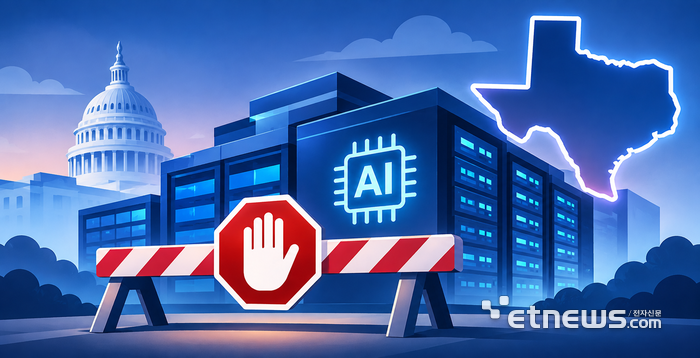
As Democrats secured a decisive victory in the U.S. midterm elections, concerns over data center permitting regulations triggered volatility in South Korean and U.S. semiconductor stocks. The domestic semiconductor industry, academia, and investment sectors have urged a calm assessment, emphasizing the need to distinguish between short-term market overreactions and long-term industry trends.
According to industry and investment sources on the 8th, the consensus view is that the practical impact of U.S. state and local government data center regulations on South Korea's semiconductor supply chain will be limited.
Indeed, after a midweek plunge, semiconductor stocks in both countries showed rapid stabilization, with the Philadelphia Semiconductor Index in New York rebounding 4.21% over the weekend. The domestic market also saw a recovery on the 6th, as individual and institutional investors turned net buyers, narrowing the intraday decline by over 2 percentage points from its low and closing with reduced losses, signaling an exit from extreme selling pressure.
Analysts attribute the recent volatility to short-term panic rather than fundamental demand contraction. Experts view the downturn as a temporary “overshooting” driven by macroeconomic fatigue and political uncertainty, rather than a reflection of weakened real-world demand.
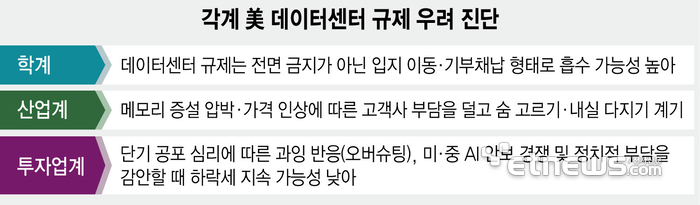
Lee Hyun-kwon, head of the Gyeongbuk-Gumi Semiconductor Materials and Parts Specialized Complex Promotion Team (professor at Kumoh National Institute of Technology), analyzed, “In a situation where massive borrowing continues to fund data center investments amid high interest rates, skepticism in the market has accumulated regarding the timing of revenue recovery from business-to-business (B2B) transactions. Additionally, uncertainties about the Democratic Party's potential loss of support for pro-AI policies due to its congressional dominance have compounded, leading the stock market to react preemptively and overly sensitively.”
An investment industry insider similarly noted, “This is a prime example of fear overtaking the market, though doubts remain about the sustainability of the downward trend. From the Democratic Party's perspective, with a presidential election two years away, outright blocking data center construction—thereby hindering AI expansion—could prove politically toxic.”
Given the U.S.'s bipartisan 'AI security' stance, the prevailing view is that excessive regulation lacks practicality. In the context of the power struggle with China, it would be difficult to impose extreme restrictions on domestic data center construction.
An academic source predicted, “Rather than outright bans, U.S. state regulations are more likely to take the form of relocating facilities to peripheral areas or, as seen with Amazon, requiring infrastructure cost-sharing through 'donations' to local communities.”
In the industrial field, some voices suggest that the current shortage of AI infrastructure could serve as an opportunity for 'catching one's breath' and 'strengthening fundamentals.' A senior executive at a domestic semiconductor company remarked, “Data center operators are fiercely competing to secure memory supplies, pushing companies to expand production capacity (CAPA) at all costs. The burden of price hikes and client relations is also significant. If the pace slows, suppliers could welcome reduced pressure to expand and ease concerns over price increases.”
A semiconductor packaging expert emphasized, “With the future direction of AI clearly defined, a temporary adjustment in production and sales speed could instead become an opportunity to accelerate research and development (R&D). If corporate resources, previously focused on mass production and delivery, gain breathing room, that capacity should be boldly redirected to next-generation R&D to solidify a super-gap advantage.”
Analysis suggests that the foundational strength of the domestic semiconductor ecosystem is sufficient to withstand short-term external pressures.
Lee added, “Key AI chips, such as high-bandwidth memory (HBM), are effectively sold out until 2028-2029, and the upstream materials, parts, and equipment (MPB) ecosystem is also securing volumes and proceeding with expansion investments. However, we must remain vigilant and respond to indirect ripple effects and policy uncertainties stemming from U.S.-origin regulatory noise.”
