




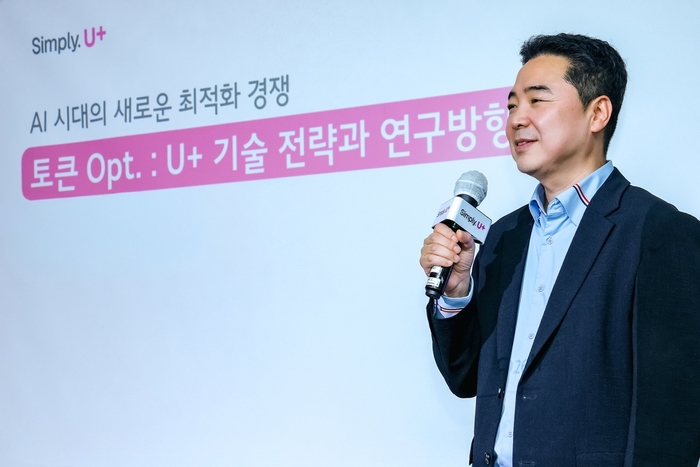
LG Uplus will enter the artificial intelligence (AI) token business next year. The company aims to reduce the burden of AI transformation (AX) on enterprise customers through its in-house token optimization technology. Its strategy focuses on lowering the total cost of ownership (TCO) required to complete business tasks by combining model routing, model compression and chip mixing.
“Competition for dominance in the AI market has shifted beyond who can build the largest model to how precisely and economically companies can deliver the business outcomes customers want,” said Lee Sang-yeop, chief technology officer (CTO) of LG Uplus, on Nov. 15. “Rather than simply competing on token prices, reducing the total cost of completing a task will become the technological moat of the AI business.”
LG Uplus emphasized its technological capabilities in optimizing every layer, from AI agents to semiconductors, as an integrated system. Its core technologies include “harness engineering,” which designs AI agents' task execution paths; “intelligent routing,” which assigns models according to the type of question; and “chip mixing,” which uses heterogeneous semiconductors to optimize inference.
First, the company reduces token consumption by preventing AI agents from repeatedly performing unnecessary searches or verification during task execution and connecting them to the optimal models based on task difficulty. LG Uplus has also secured proof-of-concept (PoC) results demonstrating a 25% reduction in the cost of processing general queries and a reduction of more than 30% in coding agent costs. “We also confirmed a 90% reduction in AI model operating costs in coding tasks, which consume large amounts of tokens,” the company said.
LG Uplus is also combining model compression with inference optimization technologies. Its proprietary on-device AI model has been reduced to approximately one-third of its original size while retaining more than 95% of the performance of general-purpose cloud models. By using a smaller model to generate responses quickly and a larger model to verify them, the company has more than doubled token generation speed. It has also increased processing efficiency to approximately four times that of the same infrastructure by changing its computational processing methods.
For infrastructure, LG Uplus has adopted a “chip mix” strategy. The company combines graphics processing units (GPUs) from Nvidia and AMD with domestically developed neural processing units (NPUs) from FuriosaAI, dividing tasks between question analysis, known as prefill, and response generation, known as decode. The architecture reduces infrastructure costs by distributing workloads that require extensive computation and those that depend heavily on memory bandwidth.
LG Uplus plans to begin targeting the business-to-business (B2B) AI token market in earnest next year through a combination of partnerships with other companies and direct infrastructure development. With LG Uplus entering the market, all three major South Korean telecommunications operators will be participating in the token economy. KT previously launched Token Factory, an enterprise platform that supports automatic AI model routing and billing management, while SK Telecom has introduced Token Gateway as a new business initiative.
“By combining globally competitive model compression and inference technologies with the optimization expertise we have accumulated through our ixi-O and AI for All businesses, we will provide services that enable enterprise customers to achieve the best AI outcomes at reasonable costs,” Lee said.
