





European home appliance manufacturers have urged relevant authorities to strengthen carbon regulations and customs controls on imported appliances. The move is seen as an effort to impose additional restrictions on products manufactured outside Europe, citing the weakening of the region's manufacturing base.
Concerns are growing that if Europe's efforts to protect its domestic industries translate into regulations, they could create new trade barriers not only for Chinese companies but also for South Korean appliance manufacturers such as Samsung Electronics and LG Electronics.
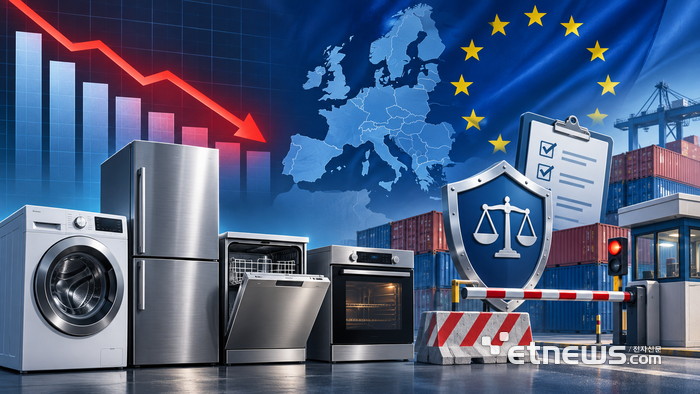
APPLiA, the European home appliance industry association, recently released a proposal titled “A European Action Plan for Household Appliances,” calling on the European Commission and European Union (EU) member states to develop a dedicated plan to strengthen the competitiveness of the appliance industry by 2027.
According to APPLiA, the share of appliances consumed in Europe that are manufactured within the region has fallen from more than 80% to 71% over the past decade. More than 20,000 appliance manufacturing jobs have also been lost over the past five years.
APPLiA warned that if sales of locally manufactured products continue to decline and production facilities continue to relocate overseas, the region's component supply chains and research and development capabilities could also weaken.
European appliance manufacturers are calling for stricter trade regulations on products manufactured outside the region. They have proposed expanding the scope of the Carbon Border Adjustment Mechanism (CBAM) to include dishwashers, ovens and freezers.
The industry has also called for tighter controls on imported products. It argues that authorities should strictly verify whether companies have designated a responsible economic operator within the EU and completed producer registration under the Waste Electrical and Electronic Equipment (WEEE) regulations during customs clearance and online distribution. It also wants stronger oversight of compliance with existing product regulations.
If these demands are reflected in policy, appliances manufactured outside Europe and exported to the region could face higher costs and greater administrative burdens. Expanding the scope of CBAM could introduce additional requirements for calculating and verifying carbon emissions generated during manufacturing, along with associated costs. Stricter product registration requirements and enforcement of environmental regulations would also create additional compliance obligations for exporters.
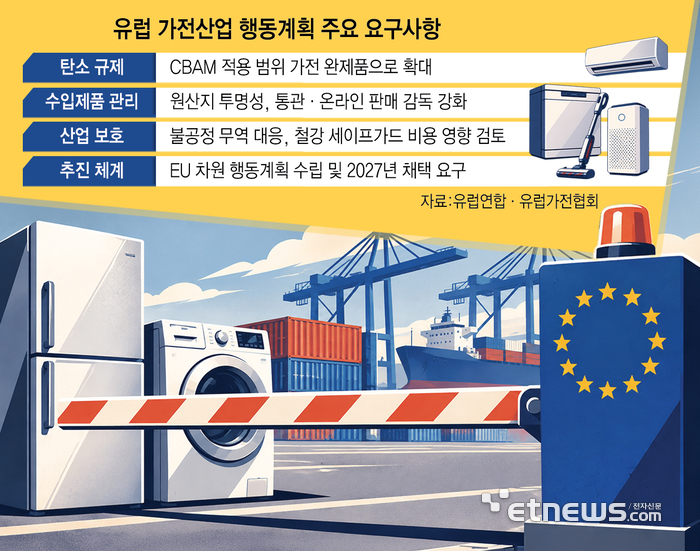
Calls to protect the appliance industry are spreading beyond manufacturers to the level of EU member states. Six countries — France, Germany, Italy, Poland, Spain and Slovakia — jointly proposed the establishment of a dedicated action plan for the appliance industry at the EU Competitiveness Council in September.
Concerns over the expansion of EU regulations are also being raised in South Korea. At the 14th Korea-EU Free Trade Agreement (FTA) Committee on Trade in Goods held last month, the Ministry of Trade, Industry and Resources requested that new regulations, including CBAM, not impose excessive burdens or create unreasonable trade barriers for South Korean companies.
“If Europe's policies to protect its appliance industry gain momentum, South Korean companies could find themselves having to secure the competitiveness of their production facilities within Europe while also responding to trade regulations on products manufactured outside the region,” a South Korean home appliance industry official said.
“There is also an urgent need for South Korea to develop proactive support measures that take geopolitical circumstances into account,” the official emphasized.
