








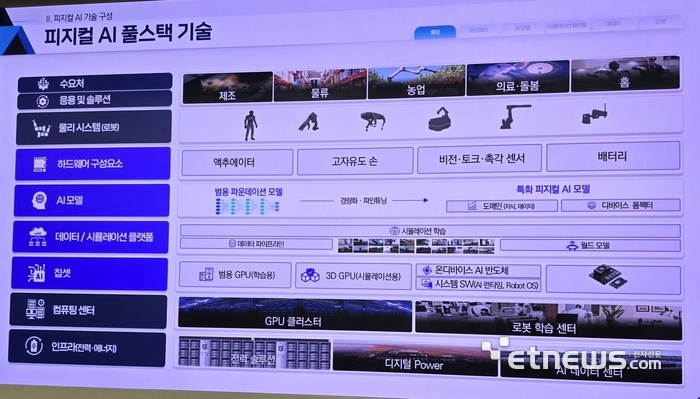
The South Korean government, in partnership with the private sector, is launching a major initiative to embed “Physical AI”--artificial intelligence integrated into physical systems such as robotics and machinery--across national infrastructure, industry, and daily life. With a planned investment of 1.4131 trillion won over the next five years through 2030, the project aims to drive balanced national growth by accelerating regional AI transformation (AX).
The Ministry of Science and ICT (MSIT) has unveiled the blueprint for its “Strategy to Secure Core Competitiveness in Physical AI,” which fleshes out one of the country's three flagship mega-projects. The initiative targets breakthroughs in key industries to widen South Korea's technology lead, introduces welfare solutions such as a “one robot per household” vision, and seeks to build a robust safety net to eliminate workplace fatalities. The ministry plans to localize full-stack technologies through pioneer projects and to build a uniquely Korean ecosystem by validating these tools in regional AX programs. This strategy builds on successful pilots in Jeonbuk and Gyeongnam Provinces last year, which boosted industrial productivity by more than 20%. Looking ahead, the government expects that a 20 trillion won budget allocation for Physical AI will ultimately generate around 100 trillion won in economic value.
To support this infrastructure, the government will aggregate data across multiple ministries into a centralized “pan-government data library.” It will also collect domain-specific data from sectors such as manufacturing, mobility, and agriculture to provide the high-quality datasets required to train sophisticated Physical AI models.
On the technical front, South Korea is focusing on developing general-purpose Physical AI models capable of autonomous planning and precision manipulation. Following a competitive bidding process, a consortium led by LG Electronics has begun work on a “world model”--an AI system that predicts environmental changes and runs simulations to optimize decision-making and learning. Researchers will also develop ultra-low-latency, low-power, high-performance AI semiconductor platforms to ensure that models can run smoothly on devices without relying on the internet. By combining data infrastructure, world models, and custom chips, the government plans to build a “full-stack AI factory” that enables fully autonomous manufacturing.
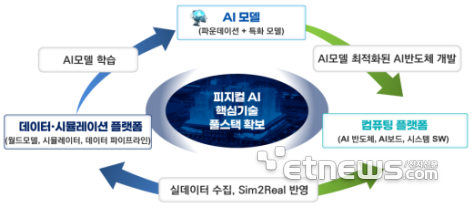
Regional economies will serve as the primary testing ground for these advances. In Gyeongnam Province, a 676.3 billion won project over five years will focus on developing human-AI collaborative models featuring real-time intelligent precision control and physical intelligence behavior models. This technology will allow factory equipment to predict its own operational status and self-optimize, directly benefiting the local home appliance, automotive, and defense sectors. Meanwhile, Jeonbuk Province will secure systems engineering capabilities to predict factory conditions and enable flexible production, establishing a collaborative intelligent factory system for the automotive industry. Jeonbuk plans to invest roughly 736.8 billion won over five years to acquire manufacturing-specific software platform technologies.
The MSIT plans to lay the groundwork for Physical AI this year and to establish a self-sustaining data “flywheel” by next year. By developing and validating data-driven behavioral intelligence, world models, custom semiconductors, and simulators, the ministry aims to achieve human-level manipulation capabilities in machines. Bae Kyung-hoon, Vice Minister of Science and ICT, emphasized the government's commitment, stating that South Korea will support a homegrown, full-stack ecosystem that integrates high-quality data, cutting-edge models, computing platforms, telecommunications, and security--with the ultimate goal of exporting South Korean Physical AI technology globally.
