








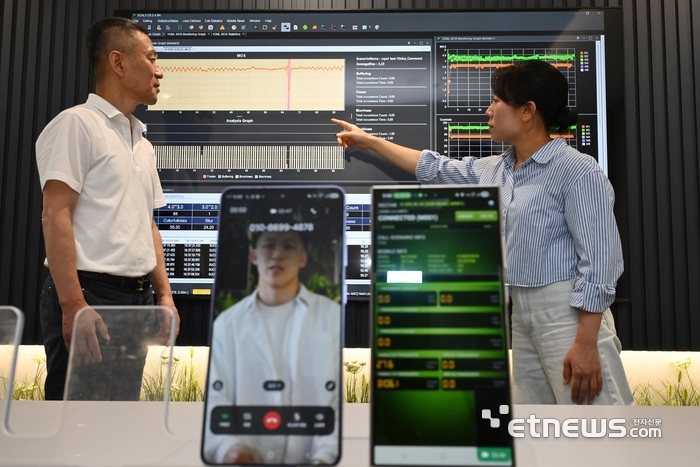
LIG Acuver's proprietary artificial intelligence (AI)-based video quality assessment technology, VQML, has been adopted as an international standard, marking a major milestone for South Korea in the global AI and video technology market. The achievement demonstrates the company's technological edge over global Big Tech competitors and positions Korea to lead the next-generation video quality assessment industry.
According to industry sources on July 7, the International Telecommunication Union's Telecommunication Standardization Sector (ITU-T) officially selected VQML as the baseline model for its J.noref video quality assessment standard during a recent meeting in Geneva, Switzerland.
Following final administrative approval, VQML is expected to become the world's first international standard for AI-based video quality assessment. The solution uses AI and deep learning to predict the quality of received video streams in real time.
VQML competed directly against Google's YouTube technology during the standardization process. ITU-T experts awarded higher scores to LIG Acuver's technology, leading to its selection as the international standard.
The company developed a proprietary algorithm trained on a massive dataset built from large-scale user surveys. Combined with deep learning, the algorithm accurately evaluates video quality without requiring the original reference video. It also accounts for factors such as network conditions and device-specific display resolutions to produce more reliable and objective quality scores.
Conventional video quality assessment typically relies on the Mean Opinion Score (MOS) method, in which human evaluators compare original and received videos. This approach is costly, time-consuming, and difficult to standardize because it requires storing original content. LIG Acuver's AI-based approach overcomes these limitations.
The new standard is significant because it establishes, for the first time, an objective, real-time metric for measuring Quality of Experience (QoE)--a metric that has traditionally depended on subjective human evaluation.
The importance of QoE continues to grow as high-definition streaming, video conferencing, and other video-centric services expand. It is also becoming increasingly critical in safety-sensitive applications such as remote monitoring and autonomous driving, where even minor degradation in video quality can affect user experience or operational safety.
While South Korea has long been a leader in telecommunications infrastructure and devices, it has relied on foreign standards--and paid licensing fees--for core measurement technologies such as voice quality assessment. Industry observers believe the adoption of VQML gives Korea a strategic opportunity to lead the global video quality assessment market.
Ahead of the publication of the ITU standard documents, LIG Acuver has already filed patents covering its core technologies. The company also plans to commercialize its intellectual property by licensing the technology to domestic and international equipment and solution providers.
