








Researchers at the Korea Advanced Institute of Science and Technology (KAIST) have developed a new display technology that preserves the original shape of text and images even when the screen is stretched. The breakthrough is expected to accelerate the commercialization of next-generation high-resolution stretchable displays by overcoming one of the technology's biggest challenges--image distortion.
KAIST announced on July 8 that a research team led by Professor Seung Hyup Yoo of the School of Electrical Engineering, in collaboration with Professor Han-Eol Moon of Dong-A University, has developed a stretchable display platform capable of expanding uniformly in every direction while maintaining the correct proportions of on-screen images.
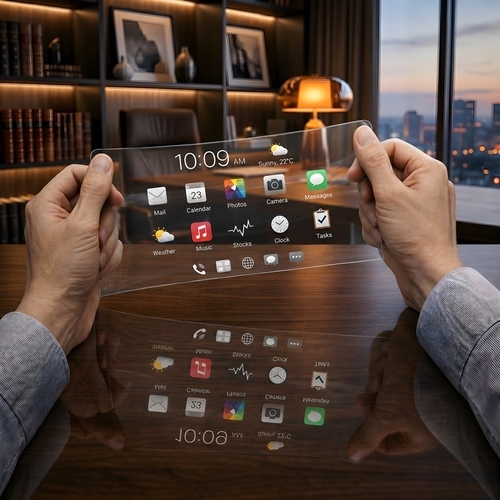
Conventional stretchable displays typically place light-emitting devices on an elastic substrate. However, when the screen is stretched in one direction, it tends to contract in the perpendicular direction, causing text and images to become distorted.
To address this issue, researchers have adopted auxetic structures, which expand in both width and length when stretched. Yet conventional auxetic designs transmit twisting deformation to the substrate as they expand, resulting in warped on-screen images.
The KAIST team overcame this limitation by introducing a new structural design. Instead of bonding the auxetic structure to the stretchable substrate across the entire surface, the researchers used precise calculations to selectively connect only specific points where support was needed. This approach enables not only the overall display but also small elements such as text and graphics to expand uniformly while preserving their original shape.
The team validated the technology by repeatedly stretching a substrate printed with text and graphic patterns in both horizontal and vertical directions. While conventional designs showed noticeable distortion, the new platform maintained the original appearance of the patterns throughout the stretching process.
The researchers also integrated an LED array onto the platform to demonstrate its performance as a functional stretchable display. The prototype maintained stable electrical operation and consistent brightness even when stretched by up to 15% in both directions. After repeated stretching cycles to the same level, brightness degradation remained below 2%, confirming the technology's potential for practical display applications.
The technology is expected to serve as a core platform for future shape-adaptive electronics, including wearable devices, electronic skin, medical biosensors, soft robots, and flexible displays for automobiles and aircraft.
“Our platform enables uniform expansion from individual pixels to the entire display, making it a key enabling technology for the commercialization of high-resolution stretchable displays,” said Professor Seung Hyup Yoo.
The study, led by KAIST researchers Subon Kim and Junho Kim as co-first authors, was published in Nature Communications on June 10.
