








Sharp increase in new registrations last year
“Criteria met only under specific conditions”
KEA recommends system improvement
Suspicion has been raised that Chinese home appliance companies are labeling their energy efficiency ratings higher than their actual performance in the South Korean market. Critics point out that these companies are “bypassing” Korea's testing system by designing products to meet the standards only under specific conditions.
While China is tightening regulations because it cannot trust the energy efficiency of its own companies, Korea lacks regulations to prevent such “test bypassing.” Furthermore, follow-up management and penalties are not being properly implemented.
It was confirmed on July 2 that the Korea Electronics Association (KEA) requested the Korea Energy Agency to strengthen its follow-up management system, citing suspicions that some Chinese home appliances, such as washing machines and refrigerators, are bypassing energy efficiency rating standards.
In fact, when a domestic home appliance manufacturer conducted its own testing on some Chinese products, multiple cases were identified where products were suspected of matching the displayed rating by detecting specific test conditions--such as temperature, humidity, and load--and lowering energy consumption accordingly.
The current energy efficiency rating system is structured so that a rating can be obtained as long as the measured values meet the criteria under designated test conditions. The domestic appliance industry believes that Chinese companies are exploiting this institutional loophole, applying bypass designs that switch to a different logic from normal usage conditions the moment test conditions are detected.
These suspicions arose as the number of Chinese home appliances obtaining energy efficiency Class 1 surged last year. In particular, Midea and TCL registered four and six energy efficiency Class 1 refrigerators, respectively, for the first time last year. Before that, they did not have a single Class 1 product. The same goes for washing machines. Last year alone, the number of newly registered Class 1 washing machines from Midea and TCL reached six and 15, respectively.
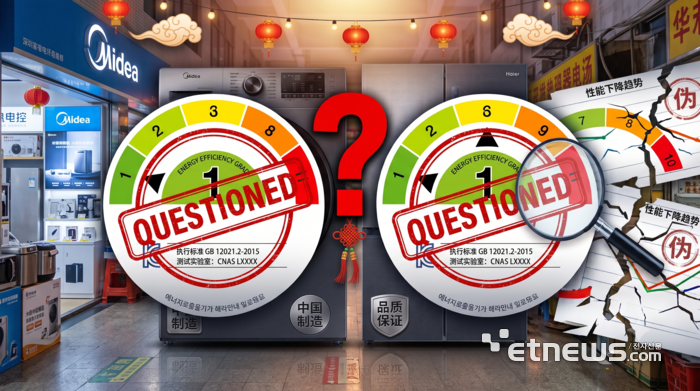
The “blind” energy efficiency rating calculation of Chinese appliances is such a sensitive issue that even the Chinese government has taken steps to improve the system.
According to the Korean Agency for Technology and Standards, China's State Administration for Market Regulation introduced an “anti-bypass mode inspection test” as a mandatory test item last month to prevent manufacturers from abusing test modes. If a test is found to have been performed in a bypass mode, the test results are determined to be invalid.
An official from the home appliance industry said, “Some Chinese products appear unlikely to achieve the efficiency of their displayed ratings under normal usage environments.” The official added, “If they lower energy consumption only under fixed test conditions, it is an act of deceiving consumers, but it is not easy to detect or sanction this under the current system.”
In Korea, there is no way to prevent such intentional bypass designs. Europe defines products designed to intentionally detect that they are under test and alter their performance accordingly as bypass products. The International Electrotechnical Commission (IEC) also defines specific “test bypassing” behaviors for each item. No such system exists in Korea.
Follow-up management is also poor. The Korea Energy Agency randomly collects a certain amount of distributed products every year to conduct retesting. Since follow-up inspections are conducted based on market share, the likelihood of retesting is not high. Even if a rating is found to be non-compliant, the penalty is limited to correcting the display details or imposing a fine of up to 20 million won. This is why aggressive rating calculations by Chinese appliance companies are possible.
The KEA has recommended system improvements to the Ministry of Climate, Energy and Environment and the Korea Energy Agency to patch the institutional loopholes. The home appliance industry argues that stronger follow-up measures are necessary, such as establishing new anti-test-bypass regulations and ensuring that foreign products above a certain approved quantity or ratio are included when selecting models for follow-up management.
