






The South Korean government is investing approximately KRW 90.1 billion (about USD 65 million) to develop domestically produced on-device AI semiconductors capable of processing artificial intelligence directly within home appliances without relying on cloud services or internet connectivity. As global technology giants including Samsung Electronics, LG Electronics, Google, and Amazon intensify competition to dominate the smart home ecosystem, the initiative aims to reduce Korea's dependence on foreign technologies by securing indigenous AI chipsets and platforms.
The Ministry of Trade, Industry and Energy (MOTIE) is launching the K-On-Device AI Semiconductor Technology Development Project to establish domestic technologies and an industrial ecosystem for on-device AI in home appliances. The program will run for 54 months, with government funding totaling KRW 90.1 billion, including KRW 18.8 billion allocated for this year.
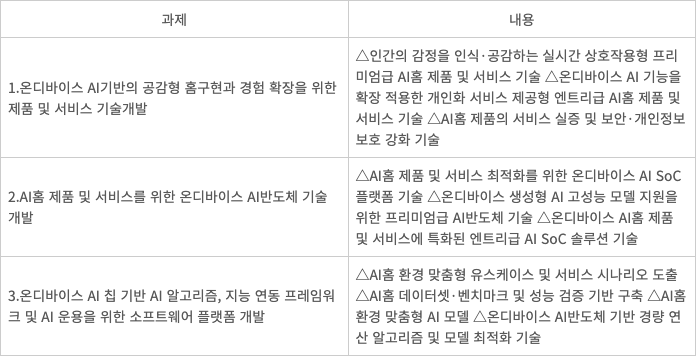
The project consists of three integrated subprograms. The largest, “Development of On-Device AI Semiconductor Technology for AI Home Products and Services,” accounts for KRW 78 billion--approximately 87% of the total budget. Its primary objective is to establish a full lineup of AI system-on-chip (SoC) solutions, ranging from premium to entry-level models, to support a broad spectrum of smart home devices.
The first subproject, with a budget of KRW 5.3 billion, focuses on developing products and services that deliver empathetic AI-powered home experiences. The initiative will develop lightweight speech recognition, natural language processing, and generative AI modules capable of operating with low power consumption and minimal latency. It also aims to integrate multimodal data processing and real-time user emotion and context recognition into at least five domestically developed AI home products. Beyond chip development, the project seeks to validate AI technologies in commercially viable consumer products.
The second subproject centers on creating the architectural foundation for domestic AI chips. Researchers will develop an open, modular, and scalable SoC platform composed of modular intellectual property (IP) blocks--including processors, neural processing units (NPUs), and sensor I/O components. This modular architecture will enable manufacturers to rapidly produce derivative chips tailored to different performance, power, and cost requirements, addressing structural weaknesses in Korea's fabless semiconductor industry.
Premium SoCs will be designed to support high-performance, low-latency on-device generative AI, multimodal perception, and context-aware interactions. Entry-level chips, meanwhile, will prioritize essential AI functions such as always-on voice recognition, basic computer vision, and energy optimization while minimizing power consumption and production costs.
The third subproject, funded with KRW 6.3 billion, will develop AI algorithms, an intelligent interoperability framework, and a software platform to support on-device AI deployment. A key objective is to make the technology accessible to small and medium-sized enterprises (SMEs). Performance targets include reducing AI model size by more than 50% while maintaining at least 95% of original accuracy. By providing software development kits (SDKs), application programming interfaces (APIs), and an integrated development environment (IDE), the project aims to enable SMEs in the home appliance and IoT sectors to adopt on-device AI without requiring advanced in-house AI expertise. The initiative emphasizes expanding the demand-side ecosystem alongside semiconductor supply.
Security has been identified as a core element of the project. Local data processing, encryption, secure over-the-air (OTA) software updates, and technologies that minimize external transmission of personal data will be incorporated into chip designs from the outset.
Because on-device AI performs inference locally rather than through cloud servers, it inherently reduces the risk of personal data leakage. As dependence on global technology platforms continues to grow, concerns over data sovereignty have also increased, making domestic on-device AI semiconductor development a strategic national priority.
The project is expected to provide substantial benefits to Korean fabless semiconductor firms, home appliance manufacturers, and IoT companies, particularly SMEs. Participation by domestic fabless companies is mandatory, while the use of Korean semiconductor foundries and locally developed semiconductor intellectual property (IP) is strongly encouraged.
An industry official expressed optimism that the project would establish a shared infrastructure enabling smaller appliance and IoT companies with limited AI capabilities to adopt on-device AI technologies more easily through standardized SDKs, APIs, and integrated development tools.