




NVIDIA has adjusted the bandwidth (speed) target for the 6th-generation high-bandwidth memory (HBM4) to be mounted on its next-generation AI accelerator platform, 'Vera Rubin.' This strategic move is interpreted as prioritizing stable initial production volumes and yield rates over self-inflicted supply bottlenecks by insisting on overly high specifications.
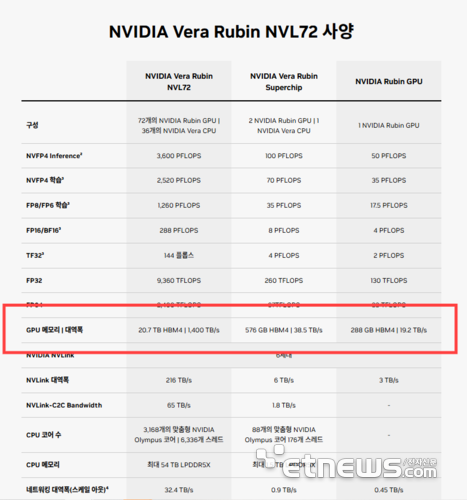
According to industry sources on the 27th, NVIDIA recently revised the HBM4 memory bandwidth per GPU in the Vera Rubin specification datasheet on its official website from 22 terabytes per second (TB/s) to 19.2 TB/s, a reduction of approximately 13%.
The total bandwidth for the rack-level system 'NVL72' was also adjusted from 1,580 TB/s to 1,400 TB/s. Core specifications such as HBM4 capacity (288 GB) and NVFP4 computing performance remained unchanged. NVIDIA made these changes by modifying product webpage specifications without a separate announcement.
The key adjustment involves easing the memory 'pin speed.' To achieve the original 22 TB/s bandwidth with HBM4's 2,048 data input/output (I/O) channels, each pin would need to operate at approximately 11.7 Gbps. The revised 19.2 TB/s corresponds to a pin speed of 9.4-9.6 Gbps, effectively lowering the data transfer limit while maintaining the same number of I/O channels. Even with the adjustment, the performance still exceeds twice that of the HBM3E (approximately 8 TB/s) used in the previous-generation Blackwell.
The semiconductor industry views this as a decision considering 'mass production feasibility.' With HBM4 introducing foundry logic processes to the base die for the first time, technological complexity has surged, making yield management difficult if only high-speed (high-bin) products are prioritized. By adopting a more achievable stable speed (low-bin) as the standard specification, NVIDIA appears to aim for a broader supply chain foundation.
This adjustment is expected to positively impact all three memory manufacturers—Samsung Electronics, SK Hynix, and Micron—by easing process burdens. Lowering the required speed threshold improves mass production yields and increases the volume of valid products that can pass NVIDIA's quality certification (qual test). Against the backdrop of exploding AI accelerator demand, SK Hynix and Samsung Electronics are anticipated to accelerate their supply expansion.
However, the calculus for suppliers has become more complex. For leading companies that previously held an edge in high-speed operation capabilities, the 'technological premium gap' with followers may narrow. Conversely, Micron, which has reportedly faced challenges in early HBM4 supply chain entry, could gain a foothold for catching up due to the relaxed standards.
An industry insider commented, “NVIDIA's specification adjustment reflects a pragmatic compromise, prioritizing actual mass production volume and system stability over marketing-centric figures. As NVIDIA moves to resolve memory bottlenecks and solidify a multi-vendor system, the early market share competition in the HBM4 sector is expected to enter a new phase.”
