








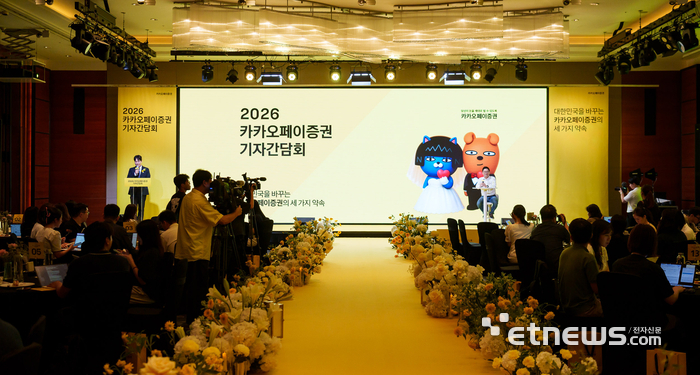
Kakao Pay Securities has unveiled a plan to expand Korea's investor base to 20 million people within three years, led by personalized artificial intelligence investment agents.
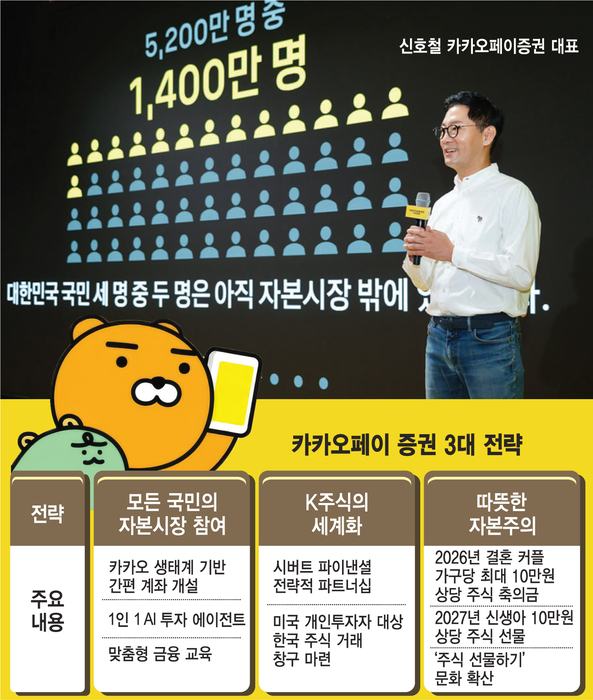
At a press conference in Seoul on July 23, CEO Shin Ho-cheol outlined three strategic priorities: broadening public participation in capital markets, bringing Korean equities to global investors, and promoting what the company calls “warm capitalism.”
“Two out of every three Koreans are still outside the capital markets,” Shin said. “We aim to create an era in which 20 million people invest within three years.” He added that the goal is not simply to open more brokerage accounts, but to help account holders invest responsibly and build long-term wealth.
The company plans to lower barriers to investing by integrating its services across KakaoTalk, Kakao Pay and KakaoBank. It also intends to provide stocks at major life milestones, including marriage and childbirth, then use AI to support customers with financial education and investment-information analysis based on their financial circumstances, investment preferences and life stages.
At the center of the strategy is a “one AI investment agent per person” model. The agent will provide personalized investment information based on a user's portfolio, investment experience, risk tolerance and life stage. It is also designed to help investors understand product structures, risks and potential returns.
Shin said trust matters more than making AI simply more sophisticated. The company aims to build AI that represents the customer's interests rather than those of the brokerage, he said. The planned service will use explainable AI, allowing users to understand the basis for its responses and the data used to generate them.
To reduce hallucinations associated with generative AI, Kakao Pay Securities plans to use validated data, ontologies and knowledge graphs, while building proprietary AI infrastructure to reinforce personal-data protection and service reliability.
Some functions of the AI investment agent are scheduled to launch by the end of this year. The company plans to make the agent accessible beyond its own app, allowing users to connect it with services of their choice, including messenger platforms such as KakaoTalk and potentially Telegram.
Kakao Pay Securities has invested approximately 200 billion KRW in system development, server capacity and related technology infrastructure. IT spending accounts for about 20% to 30% of revenue, according to the company.
Shin said revenue has grown by roughly 75% annually over the past three years, alongside rapid customer growth. As a result, he said the level of technology investment is not excessive, while fixed investment costs relative to profit have fallen by nearly half from three years ago, reflecting economies of scale.
The company will also use its “warm capitalism” strategy to draw first-time investors into capital markets. Couples who register their marriage this year will receive up to 100,000 KRW in stock per household. Starting in 2027, every newborn will receive stock worth 100,000 KRW per child.
“I hope every baby born next year will have a stock account,” Shin said, adding that the company has a responsibility to provide financial knowledge and investment education so customers can become informed, long-term investors.
Kakao Pay Securities also plans to improve access to Korean equities for overseas investors. It is preparing a Korea-stock trading service for U.S. retail investors with Siebert Financial, a Nasdaq-listed U.S. brokerage firm, with a launch targeted for the first half of next year. Through Siebert's brokerage platform, U.S. retail investors would be able to trade Korean stocks. The companies are also reviewing tokenization as a potential route to 24-hour trading within the U.S. regulatory framework.
