








Sandisk is expanding its smartphone external storage lineup in South Korea, including its Phone Drive products. With NAND prices rising and high-capacity iPhone models getting much more expensive, the move appears aimed at a niche of consumers who want more storage without paying Apple's premium.
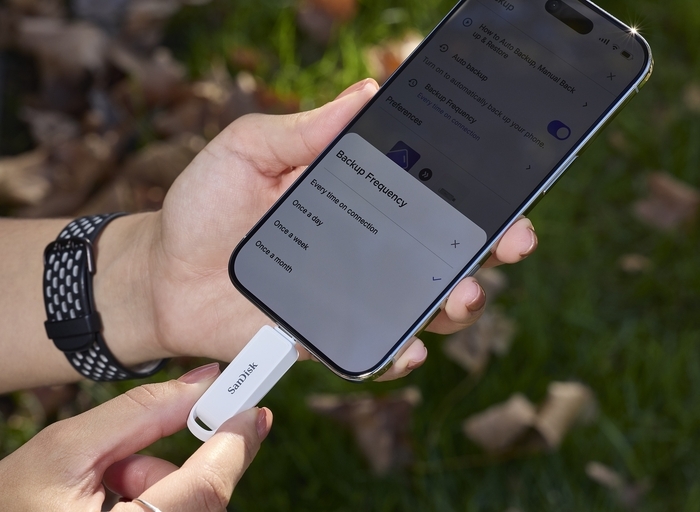
According to industry sources on Monday, Sandisk recently launched a 1-terabyte (TB) Phone Drive for iPhone in the Korean market. The product has a single USB-C connector and plugs directly into compatible iPhones, iPads and Macs, as well as other USB-C devices. It moves files by physical media rather than through the cloud, much like the USB flash drives of the past. When connected to a smartphone, it also supports automatic backup through the Sandisk app.
The idea of backing up a phone's limited storage to external NAND memory is not new. Sandisk's iXpand, released in 2015, introduced the same concept. A product that was popular a decade ago is returning because rising NAND supply prices have made high-capacity phones more expensive for consumers.
The underlying cause is the explosion in demand for artificial intelligence (AI), which has squeezed the supply of consumer NAND and DRAM. AI data centers and enterprise customers, with their demand for high-bandwidth memory (HBM) and solid-state drives (SSDs), now take up a very large share of memory wafer capacity.
In 2026 in particular, memory's share of a smartphone's bill of materials (BOM) has jumped from roughly 10% to the mid-30% range. The shortage is expected to last for some time, and that share is likely to climb further next year. Apple CEO Tim Cook, when the company raised prices on Macs and iPads this year, likened the swings in memory prices to a “once-in-a-century flood.”
Apple, for its part, appears to be turning higher memory costs into a source of revenue. Take the iPhone 17 Pro's launch prices in Korea: 1,790,000 KRW for 256GB, 2,090,000 KRW for 512GB and 2,390,000 KRW for 1TB. Each step up in storage adds 300,000 KRW.
The gap is even wider on the foldable iPhone Duo, which starts at 3,290,000 KRW for 256GB, rises to 4,190,000 KRW for 1TB and reaches 5,090,000 KRW for 2TB. That is a difference of 1,800,000 KRW between the 256GB and 2TB versions. By comparison, adding 1TB of external storage costs about 200,000 KRW, which works out to a gap of roughly 700,000 KRW in a simple comparison.
Running a separate external device does come with trade-offs, including slower transfer speeds and the hassle of carrying it around. Even so, the price burden on consumers is now seen as outweighing the convenience. Another factor is that smartphone photos and videos keep getting higher in resolution and larger in size, which has also pushed up the cost of cloud storage.
“The more photos and videos you take and the more files you store, the more important it becomes to manage the storage space on your device efficiently,” a Sandisk representative said. “Beyond securing the space you need, it is worth considering a storage setup that lets you back up important data and move it to other devices when needed.”
