







The 4th-generation synchrotron, which will elevate South Korea's advanced scientific research capabilities, has begun construction. The goal is to complete this ultra-large-scale research facility, capable of capturing nanoscale material movements, by the end of 2029, thereby strengthening research and industrial competitiveness in cutting-edge fields such as semiconductors, secondary batteries, and biotechnology.
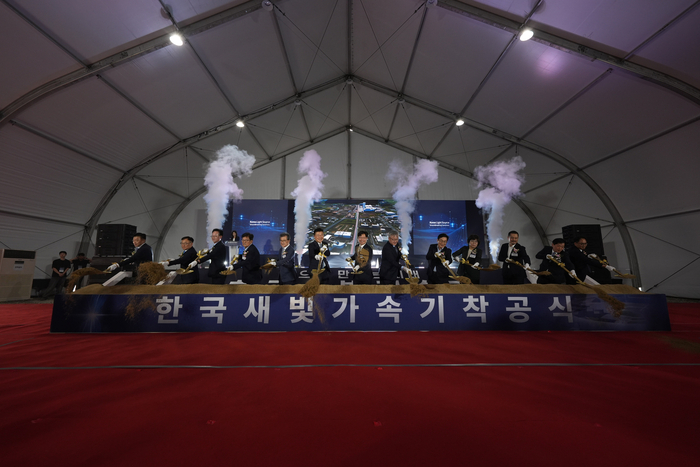
The Ministry of Science and ICT and the Korea Basic Science Institute (KBSI) held a groundbreaking ceremony for the 'Korea New Light Accelerator' on the 27th at the Ochang Technopolis in Cheongju, North Chungcheong Province.
The Korea New Light Accelerator, a 4th-generation circular synchrotron, accelerates electrons to near-light speeds, generating bright light (synchrotron radiation) to analyze material structures and properties at the atomic level with precision. Using extreme ultraviolet and X-rays emitted from the synchrotron, researchers can directly observe protein structures, cell division processes, and changes in nanoscale material properties invisible to the naked eye, earning it the nickname 'Dream Microscope.' Notable innovations like the swine flu treatment 'Tamiflu' and extreme ultraviolet (EUV) photoresists for semiconductors were developed through synchrotron research.
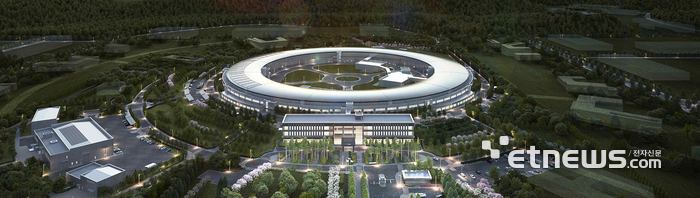
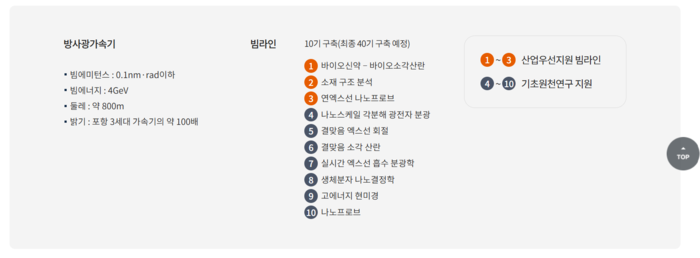
The Korea New Light Source project, initiated in 2021, aims to address the rapidly increasing demand for the existing 3rd-generation synchrotron radiation accelerator in Pohang, North Gyeongsang Province. The 4th-generation Korea New Light Source is approximately 100 times brighter than the Pohang accelerator. By December 2029, the project will construct an accelerator with a circumference of about 800 meters and 10 beamlines that function as experimental laboratories. The site spans 540,000 square meters—equivalent to 75 soccer fields—with a total budget of 1.1643 trillion won, making it a large-scale endeavor.
The Korea New Light Source will serve as a core facility for domestic researchers and industries to conduct world-class research. Of the 10 beamlines, 3 are allocated for priority industrial support in sectors such as bio, semiconductors, and secondary batteries. Unlike the 3rd-generation accelerator, which required separate measurements, the new facility enables simultaneous analysis of internal X-ray images, material properties, and electronic structures, accelerating experimental progress. Currently, 13 4th-generation circular synchrotron radiation accelerators are either operational or under construction worldwide.
The Korea Basic Science Institute (KBSI), leading the project, has pledged full operational support for the Korea New Light Source. The project team has formed a Scientific Advisory Committee to receive guidance on research topics and directions for the 10 beamline sectors. KBSI is expanding its existing synchrotron radiation accelerator cooperation with Sweden and China and accelerating efforts to attract overseas scholars.
The project will also explore the integration of physical artificial intelligence (AI) into operations. The team plans to develop an autonomous operation system by next year, where AI will monitor equipment status in real-time and predict failures in advance. Additionally, the system will be designed to allow AI to learn from experimental data produced by the Korea New Light Source in the future.
Director Shin Seung-hwan of the Multipurpose Synchrotron Radiation Accelerator Construction Headquarters stated, “The Korea New Light Source is expected to maintain the world's fourth-highest brightness performance for the next 20 years. With the commencement of construction, we will develop it into a flagship national research facility that drives innovation in basic science and strategic technology fields.”
Minister of Science and ICT Koo Hyuk-chae remarked, “As the Korea New Light Source enters the full construction phase, we will prioritize safety and rigorously manage every stage of the project. We will do our utmost to ensure the successful establishment of this world-class research infrastructure for researchers and industries.”
=Cheongju
