








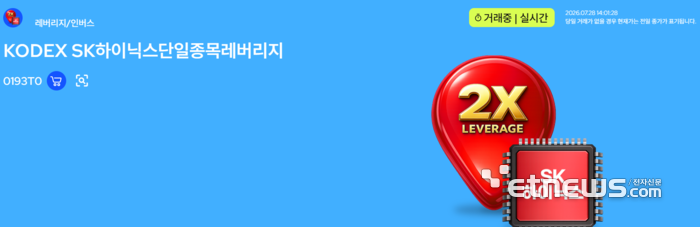
The daily trading volume of a single domestic leveraged single-stock exchange-traded fund (ETF) has surpassed seven times the combined daily trading volume of the top five domestic virtual asset exchanges. As trading in the domestic virtual asset market has dried up, individual investors' interest may have shifted to domestic stocks, leveraged products, and overseas derivatives.
According to an analysis of data from the Korea Exchange and CoinGecko as of the 28th, the average daily trading volume of Samsung Asset Management's 'KODEX SK Hynix Single-Stock Leveraged ETF' from the 1st to the 27th of this month was recorded at 4.5383 trillion KRW.
During the same period, the average daily trading volume of the five major domestic virtual asset exchanges—Upbit, Bithumb, Coinone, Korbit, and Gopax—(based on 18 trading days for ETFs) was approximately 650.3 billion KRW. The average daily trading volume of a single leveraged single-stock ETF is seven times higher than the combined volume of all five major domestic virtual asset exchanges.
Considering the difference in trading hours, the contrast becomes even more pronounced. KODEX SK Hynix Single Stock Leverage is traded for 6 hours and 30 minutes daily, from 9:00 AM to 3:30 PM, during the Korea Exchange's regular market hours. In contrast, virtual asset exchanges operate 24 hours a day.
KODEX SK Hynix Single Stock Leverage is a product that tracks twice the daily fluctuation rate of the KRX SK Hynix Index. Due to the leverage effect, losses can also be magnified if the underlying asset's price declines, making it a high-risk product. Samsung Asset Management has classified this product's risk level as the highest, Grade 1.
Virtual asset trading has been on a continuous decline. The average daily trading volume of the top five domestic exchanges in June was approximately 857.2 billion KRW (583.13 million USD). From the 1st to the 27th of this month, it decreased to about 642.3 billion KRW (436.92 million USD), a 25.1% drop.
Industry experts attribute the sluggish trading to the domestic market's structure, which is heavily focused on altcoins. Since the introduction of U.S. Bitcoin spot ETFs in 2024, institutional funds have flowed into Bitcoin, but altcoins have relatively underperformed.
The recent poor performance of newly listed coins is also cited as a factor that has diminished investor interest. In the past, newly listed virtual assets often saw high price increases, driving new investments and trading. However, recently, cases where prices fail to rise or even fall after listing have become common, reducing interest in new listings themselves.
As profit opportunities in the domestic virtual asset market have diminished, there is a possibility that individual investors' interest has shifted to the stock market. The domestic virtual asset market has limited participation from corporations and institutions, making it highly dependent on individual investors' spot trading. In contrast, the stock market has seen the rise of AI and semiconductor sectors as key themes, and the launch of single-stock leverage ETFs may have redirected some investment demand toward stocks and leveraged products.
Kim Min-seung, head of the Korbit Research Center, stated, “During the bear market that followed Bitcoin's sharp price decline in October 2025, the domestic stock market highlighted AI and semiconductor themes.” He added, “Since the domestic virtual asset market lacks institutional or corporate volume and is centered around individual investors, it is possible that some individual funds have moved to the stock market or ETF leveraged products.”
