








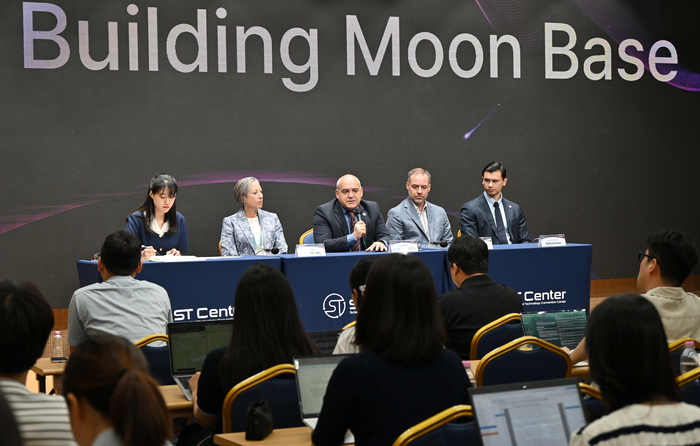
NASA, which aims to establish humanity's first lunar outpost in the 2030s, has hinted at potential collaboration with South Korea's space technology. This assessment stems from the belief that Korea's scientific and space capabilities in power, communication, energy, and robotics could accelerate the realization of the lunar base project.
Carlos Garcia-Galan, NASA's lead for the Lunar Base Program, stated at a press briefing held at the Korea Science Technology Center in Gangnam-gu, Seoul on the 29th, “NASA has completed an analysis of Korea's capabilities and identified potential collaboration in areas such as landers, mobility, and containers for lunar base construction.”
In March of this year, NASA announced the 'Lunar Base (Moon Base) Construction Plan' at the 'Ignition' event, committing $20 billion (approximately 29.4 trillion KRW) to build humanity's first permanent space habitat within a decade. Originally, NASA pursued the 'Lunar Gateway,' a space station in lunar orbit, but shifted focus to constructing a surface base for budget efficiency. The plan aims to establish the lunar south pole as a human outpost and advance exploration to deep space, including Mars.
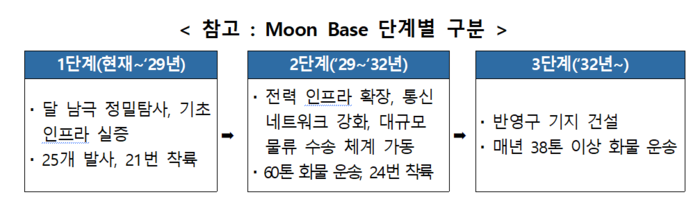
The lunar base program is divided into three main phases. First, by 2029, exploration equipment will be sent to the lunar surface to survey available resources. By 2032, initial infrastructure for astronaut habitation, such as power and communication systems, will be established. After 2032, construction of a permanent lunar base for continuous human presence will begin. Water and ice in the Moon's permanently shadowed regions (PSRs) will be utilized for drinking water, oxygen, and rocket fuel.
NASA will verify the docking system between spacecraft and commercial lunar landers in low Earth orbit next year and land astronauts on the lunar surface in 2028 to fully launch the lunar base project.
Garcia-Galan, who announced the program in March, stated, “After declaring our challenge to achieve what seemed impossible, we confirmed how to allocate personnel, budget, and resources. We have finalized scientific research goals to expedite humanity's return to the Moon, including the development of nuclear propulsion fuel.”
NASA is seeking international collaboration for the unprecedented lunar base construction. With the Japan Aerospace Exploration Agency (JAXA), they are cooperating to introduce a pressurized rover—a “wheeled habitat”—to expand human exploration capabilities by allowing astronauts to operate in everyday clothing rather than spacesuits.
In October 2024, the Korea Aerospace Research Institute (KARI) signed a research agreement for the Artemis lunar exploration program and discussed cooperative technologies for lunar base construction. The NASA project team, currently in South Korea, will hold workshops with KARI until the 31st to specify collaboration areas.
Garcia-Galan noted, “While the U.S. achieved the Moon landing alone 50 years ago, today's situation is different. We've come to South Korea to challenge the impossible with diverse international partners.” He highlighted robotics, communication technology, and low-Earth orbit satellites as key collaboration fields. Regarding nuclear propulsion fuel, which has limited cooperation due to security concerns, he stated that collaboration with South Korea is possible in principle.
The lunar base project team will unveil a detailed phase 1 execution strategy in three months. NASA plans to continue exploring collaborative ideas with governments, companies, and research institutions of Artemis Accords signatories to demonstrate foundational infrastructure.
KARI Director Oh Tae-seok stated, “As public interest in deep-space exploration grows, we will expand the Korea-U.S. civil space partnership to the lunar surface and deep-space domains starting with this workshop.”
