








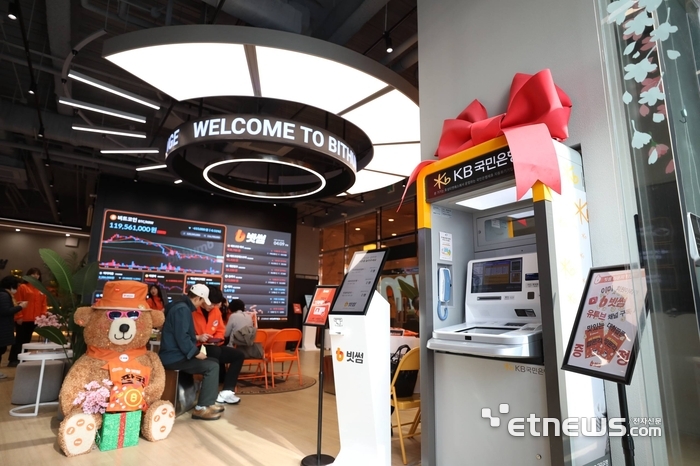
Bithumb has announced plans to strengthen internal controls, transition to international accounting standards, and reorganize its governance structure, aiming for an initial public offering (IPO) in 2028. Unlike competitors such as Dunamu (operator of Coinone), Corbit, and GOPAX—which are expanding partnerships with financial institutions and exchanges—Bithumb is focusing on a direct capital market entry through an IPO rather than attracting external strategic investors.
On the 4th, Bithumb revealed a phased roadmap, stating, “We will complete the enhancement of our internal control system and transition to the Korean International Financial Reporting Standards (K-IFRS) within the year. We plan to apply for a preliminary review for listing in 2027 and finalize the IPO in 2028.” The timeline may vary depending on market conditions and regulatory review schedules.
To enhance customer asset protection and system stability, Bithumb is overhauling its risk management and internal controls to meet financial industry standards. The company is collaborating with major accounting firms and consultants to transition from the Korean Generally Accepted Accounting Principles (K-GAAP) to K-IFRS, while also strengthening compliance monitoring and financial reporting systems for employees.
Samsung Securities has been selected as the lead underwriter. Bithumb is also working with external legal and accounting firms to evaluate corporate value, assess legal risks, and develop strategies for the preliminary listing review. Additionally, the company is diversifying its revenue structure—currently reliant on transaction fees—and securing liquid assets.
In 2023, Bithumb reported revenue of 651.3 billion won, operating profit of 163.5 billion won, and net profit of 78 billion won. Its cash and cash-equivalent assets amounted to 2.1682 trillion won. As the second-largest won-denominated virtual asset exchange in South Korea, Bithumb has demonstrated strong business performance and financial capacity.
The key challenge lies in its complex ownership structure. During the IPO process, how transparently Bithumb explains its governance—spanning Bithumb Holdings, DAA, and overseas entities—will be critical to its listing success.
Bithumb's direct shareholder structure is relatively simple: as of Q1 2024, Bithumb Holdings holds 73.56% (the largest shareholder), followed by Vident (10.22%), T Scientific (7.17%), and other shareholders (9.05%).
However, the ownership structure above Bithumb Holdings is intricate. The largest shareholder of Bithumb Holdings is the special-purpose entity DAA, which holds 34.20%. DAA's largest shareholder is BTHMB Holdings Pte. Ltd., a Singapore-based entity with 48.53% ownership. Investors must examine not only Bithumb itself but also Bithumb Holdings, DAA, and overseas entities to fully understand the actual control structure.
In August 2023, Bithumb underwent a spin-off, separating its exchange operations (retained under the existing “Bithumb”) from its holding and investment business (transferred to the new entity “Bithumb Asset”). At the time of the spin-off, Bithumb Asset was allocated assets worth 628.5 billion won, including 267.5 billion won in investment assets.
The company explained that the spin-off was intended to clarify roles and responsibilities between the exchange business and new ventures, reducing potential conflicts of interest. During the listing review, Bithumb must clearly disclose the relationship between the exchange business (Bithumb) and the transferred investment assets (Bithumb Asset), as well as the corporate value and governance of each entity.
Past failed acquisition attempts could also come under scrutiny during the IPO process. Bithumb faced challenges such as the collapse of BK Group Chairman Kim Byung-geon's acquisition attempt and issues with FTX's acquisition process, including payment delays, legal disputes, and share freezes. The preliminary review will comprehensively assess governance stability, shareholder relationships, and historical legal risks.
A Bithumb representative stated, “This IPO is not just about going public—it is a declaration to elevate the transparency and stability of virtual asset exchanges to the level of institutional finance. We will systematically fulfill the remaining listing requirements to become a company trusted by the market and investors.”
