








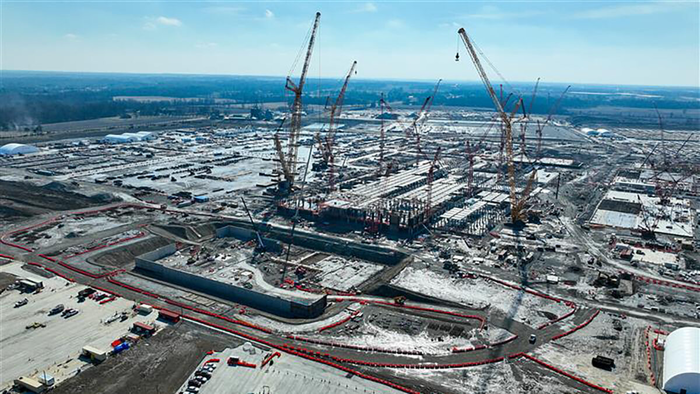
Intel's Ohio One fab project in New Albany, Ohio, has entered what appears to be an “overdrive” phase aimed at accelerating construction.
According to local job postings from the International Brotherhood of Electrical Workers (IBEW) and other sources on Aug. 5, Intel has recently mandated 50-hour workweeks for skilled tradespeople, including electricians and plumbers. Workers are being offered overtime pay at 1.5 times their regular rate, along with weekly attendance incentives of $300-$400—roughly KRW430,000-KRW570,000—for completing all scheduled shifts, as the company steps up hiring.
As of early August, construction of the main cleanroom structure had been completed, with workers being concentrated on preparations for critical utility hook-up work, including ultra-pure water (UPW) systems, central chemical supply systems (BCP), and high-voltage electrical wiring. Once these processes are completed, the site could move into the full-scale delivery and installation of manufacturing equipment.
Intel originally targeted 2025 for the start of operations when construction began in 2022. However, the schedule was postponed several times amid delays in CHIPS Act subsidies, weak semiconductor demand and Intel's financial difficulties.
In an official update issued in February 2025, Intel said it expected to complete construction of its first fab module, Mod 1, in 2030 and begin operations between 2030 and 2031. Mod 2 is scheduled for construction completion in 2031, with operations planned for 2032. Intel had previously stated that it would retain the flexibility to accelerate work should customer demand justify it.
Industry observers believe Intel's willingness to absorb additional labor costs reflects a strategy to attract outside partners, potentially through a joint venture. By ensuring that utility infrastructure is ready for rapid equipment installation and ramp-up, Intel could enhance the fab's value to potential partners.
This interpretation has gained traction because Intel appears to be accelerating some construction activity despite the easing of pressure tied to CHIPS Act funding conditions and project-progress targets following the U.S. government's acquisition of an approximately 9.9% stake in Intel in August last year.
The Ohio fab was initially designed as a leading-edge logic and foundry facility for Intel's own high-performance processors as well as customer chips for AI and data-center applications. Speculation has also emerged that SK hynix could acquire the site as part of a plan to establish a U.S.-based front-end memory manufacturing hub within five years, raising the possibility of changes to both the fab's intended production role and operating structure.
SK hynix denied the reports in a regulatory filing, saying it had neither pursued nor decided on an acquisition of Intel's Ohio site or fabs. However, the company added that it “continues to review a range of investment and acquisition opportunities in line with its business objectives.”
Local reports suggest that Intel is seeking an operating partner rather than an outright buyer, with SK hynix reportedly among the possible candidates. Formal negotiations between the two companies are not believed to have begun. Intel said it remains committed to Ohio and will continue accelerating site-readiness work.
“Because semiconductor fabs are being built simultaneously across the United States, competition for skilled construction workers has intensified,” an industry source said. “Accelerating the project could also help Intel retain key personnel and secure a stable labor supply. The construction schedule appears to be moving forward for a combination of reasons.”
