








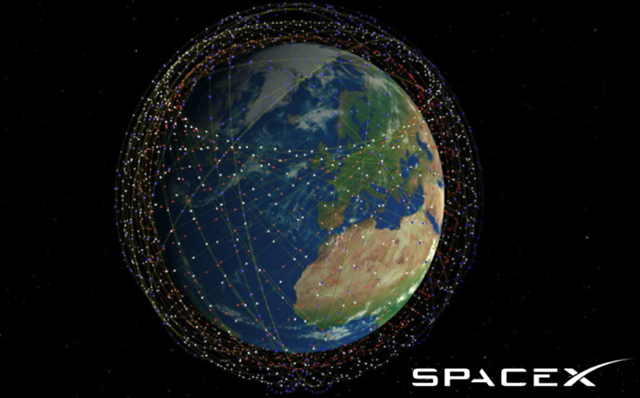
SpaceX, led by Elon Musk, has declared its ambition to dominate the telecommunications market by leveraging its low-Earth-orbit satellite network, Starlink. The company aims to account for more than half of global internet connectivity within a decade and absorb mobile subscribers through direct-to-cell (D2C) services.
Elon Musk, CEO of SpaceX, stated during the company's Q2 earnings conference call on the 4th (local time), “Starlink will be responsible for the majority of global internet access,” adding, “People are underestimating Starlink.”
Musk argued that as demand for bandwidth surges due to the spread of artificial intelligence (AI) and robotics, only Starlink's satellite network can meet this growing need.
SpaceX plans to increase the launch volume of next-generation V3 satellites by tenfold, leveraging the technological capabilities of Starship, the world's largest launch vehicle. The V3 satellites offer performance ten times greater than previous generations. Combined with increased launch capacity, transmission bandwidth is expected to grow by approximately 100 times. Gwynne Shotwell, SpaceX President, also predicted that Starlink will handle a significant portion of global internet traffic in the coming years.
The company has also solidified its plans to target the mobile market. By acquiring EchoStar's frequency band (65 MHz) and launching mobile satellites, SpaceX is accelerating its D2C business. Starlink satellites will connect directly with smartphones, eliminating dead zones and supporting voice and video calls via apps like WhatsApp and Signal.
Musk emphasized, “We will launch mobile V2 satellites aboard Starship and provide direct communication services to smartphones.” The company aims to launch mobile V2 satellites next year and begin services by the end of the following year.
Securing Ground Networks Too. CEO Musk unveiled plans to deploy femtocells—combining small base stations with Starlink antennas—on rooftops of homes and shops instead of large base stations. This approach allows network construction without investing billions in low-band spectrum acquisition.
Through this, Starlink will aggressively target the U.S. mobile market dominated by the “Big 3” carriers: AT&T, Verizon, and T-Mobile. President Jonathan Holeton cited the U.S. telecom market size at $600 billion annually, stating, “We aim to capture a significant share of their subscribers by leveraging service superiority.” Following the remarks, shares of the three carriers fell 2-4% collectively.
As SpaceX enters the telecom market, a competitive realignment between satellite operators and traditional carriers becomes inevitable. In Q2, Starlink partnered with SoftBank, NTT Docomo, and Spark New Zealand to expand into the Asia-Pacific market. Once direct satellite-device communication commercializes, the existing telecom landscape—centered on ground coverage, quality, and pricing—could be disrupted.
The earnings report demonstrated Starlink's steady growth. Q2 saw a record net subscriber addition of 1.7 million, bringing the global total to 12 million—doubling in a year.
Starlink also drove overall performance. SpaceX's Q2 revenue hit $7.8 billion (KRW11 trillion), up 92% year-over-year, with the connectivity segment (including Starlink) contributing $4.3 billion—over half the total. It was the only division to turn a profit, narrowing the company's losses.
