








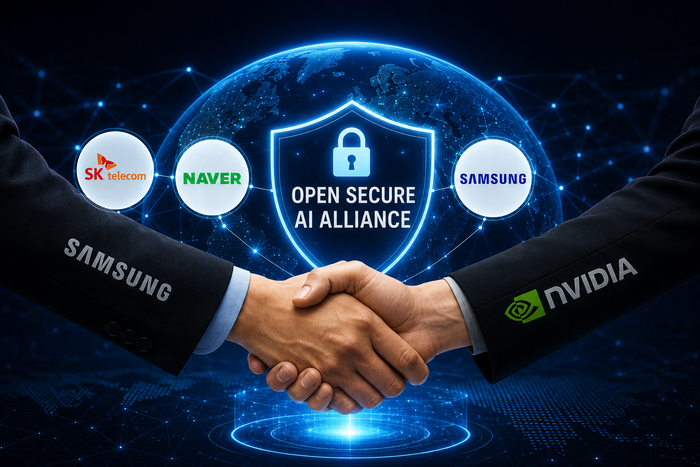
Samsung Electronics has joined the Open Secure AI Alliance, a global artificial intelligence security consortium launched under Nvidia's leadership. The move expands Samsung's collaboration with Nvidia—from networks and semiconductors into AI security.
Samsung is now the third South Korean company to join the alliance, alongside SK Telecom and Naver.
According to industry sources on Aug. 11, Samsung was recently added to the Open Secure AI Alliance's list of participating companies.
The company is expected to collaborate with major global technology firms on AI safety and security across smartphones and other consumer devices, base-station equipment, and semiconductors.
The Open Secure AI Alliance was formed to identify vulnerabilities proactively and jointly develop open security technologies in response to increasingly sophisticated threats in the AI era. Officially launched on July 27, the consortium's membership has rapidly expanded from 37 companies at launch to more than 120 within 10 days.
Samsung joined the alliance alongside Intel, Nokia, NTT, and others. Samsung and Nvidia have already worked together as founding members of the AI-RAN Alliance, launched in 2024 to develop technologies combining AI and wireless networks. In semiconductors, Samsung supplies high-bandwidth memory (HBM) for Nvidia AI accelerators.
The latest move is seen as extending cooperation between the two companies—whose businesses intersect across the AI infrastructure stack—into the area of AI safety validation.
Samsung's participation also broadens South Korea's role in global AI security cooperation into the hardware sector. While SK Telecom and Naver bring strengths in telecom networks, data centers, platforms, and AI models, Samsung has major capabilities in devices, network equipment, and semiconductors.
This could bring on-device AI and the runtime environments used by AI agents on end-user devices into the scope of international collaboration. In effect, the alliance now covers the full AI value chain.
The development also aligns with the alliance's approach to AI security, which extends beyond the model layer to cover identity authentication, access management, runtime controls, and supply-chain security.
Another potential benefit is the opportunity to shape emerging AI security standards. Participating companies began gathering feedback on a joint guideline called SAFE during Black Hat 2026, which opened in Las Vegas on Aug. 4.
The alliance is accelerating efforts to establish a framework for sharing information on AI security incidents and threats across the ecosystem, making early participation potentially advantageous.
Competition among rival AI security alliances is also seen as part of the broader backdrop. Samsung and SK Telecom, which joined the Nvidia-led consortium, had previously decided to participate in Project Glasswing, an AI security initiative led by Anthropic.
“Amid the growing reality of autonomous hacking threats powered by AI, this appears to be a strategy to participate in security standards-setting and technology responses without becoming dependent on any single camp,” an industry source said.
