








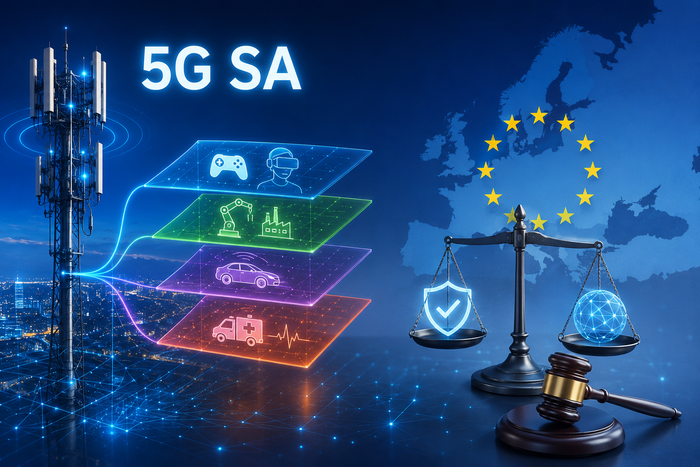
European regulators are finalizing guidelines this year for applying net neutrality regulations to new services based on 5G network slicing. As domestic carriers in South Korea, which is transitioning to standalone 5G (SA) mode this year, are increasingly rolling out specialized pricing plans based on slicing, demands for revising net neutrality guidelines are expected to grow.
According to industry sources on the 19th, the European Body of Regulators for Electronic Communications (BEREC) recently concluded a public consultation on the “Additional Guidelines on 5G Network Slicing” and will proceed to finalize the draft at its regular meeting in October.
Network slicing is a technology that divides a single physical network into multiple virtual networks to provide differentiated quality for each service, and it is only implemented in 5G SA networks. As European telecom companies introduced tiered quality-of-service (QoS) pricing plans, BEREC stepped in to establish evaluation criteria.
The EU's guidelines for network slicing services classify products that only differentiate quality metrics as customized “Internet Access Services (IAS),” while those optimized for specific purposes are categorized as “Specialized Services (SpS),” with different requirements applied.
Under IAS, quality differentiation—such as speed—is permitted across pricing tiers, provided the stated quality applies uniformly to all traffic. This does not violate net neutrality if the service remains application-agnostic, meaning telecom providers do not prioritize specific apps. However, multiple QoS tiers offering higher speeds for user-selected apps are allowed.
SpS has stricter requirements. Providers must demonstrate that the optimized service cannot be achieved through IAS alone and must proactively secure network capacity to prevent congestion before it affects IAS quality. Exceptions are made for short-term IAS quality degradation during specific events like concerts. Examples of permissible SpS include live event streaming, remote control of construction cranes, autonomous freight transport, and emergency vehicle-hospital data transmission.
Pricing plans that attach dedicated slices to specific apps on general-purpose VR/AR devices with full internet access are likely to be prohibited. Guidelines for gaming slices, which are rapidly expanding, remain pending.
The EU's net neutrality guidelines are expected to influence South Korea's regulatory policies. With all three major telecom companies preparing to adopt 5G SA this year, the Ministry of Science and ICT has formed a task force to foster innovative services.
Revising domestic net neutrality guidelines is inevitable, as the current principle of treating all data traffic equally structurally conflicts with network slicing business models. In South Korea, the “Emergency Rescue Communication Priority Service” launched in June is the first example compliant with SpS requirements under net neutrality guidelines.
A telecom industry official stated, “Domestic guidelines lack criteria for how much quality differentiation should be allowed in premium pricing plans. To develop B2C services based on network slicing, it is necessary to redefine the 2011 net neutrality guidelines.”
